One parent's (and her kids') guide to navigating the library and bookstore. My recommendations in children's book classics . . . literature for little ones, then and now.
Showing posts with label Witty. Show all posts
Thursday, July 11, 2013
Too Tall Houses
Struggling with selfishness? Got the gimmes?
Sick of hearing, "Mooooooooom! Johnny won't give it back!" or "Daaaaaaaaaaad! Sally hit me!"
While I thought that Too Tall Houses by Gianna Marino (c. 2012) presented a lighthearted (and B-E-A-U-T-I-F-U-L-L-Y illustrated) approach to this time-worn dilemma, the book sparked an interesting conversation amongst unsuspecting little listeners. And while I thought that it prompted a fortuitous response among my brood, I was pleasantly surprised to learn that my friend Sarah's brood responded the same way. So give it a whirl.
Wednesday, July 10, 2013
It Couldn't Be Worse!
So are y'all starting to get on each other's nerves yet? Your family, that is. :) Maybe in all this rain, you're driving each other up the wall? It's that time of summer when some parents and/or siblings start looking forward to school starting.
Here's a book full of laughs that just might change your perspective. Check out It Couldn't Be Worse! by Vlasta van Kampen (c. 2003). And for a sneak peek, continue reading the first page:
The tiny house had just one room.
A poor farmer, his wife, their six children, and the grandparents lived there.
They quarreled and fought and got in each other's way. . . .
Here's a book full of laughs that just might change your perspective. Check out It Couldn't Be Worse! by Vlasta van Kampen (c. 2003). And for a sneak peek, continue reading the first page:
The tiny house had just one room.
A poor farmer, his wife, their six children, and the grandparents lived there.
They quarreled and fought and got in each other's way. . . .
Saturday, June 22, 2013
Charming Opal
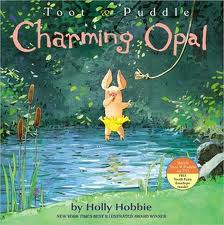
If you've been following ReadMeAStory from the beginning, you know that around here we love Holly Hobbie's Toot & Puddle characters! If you want to check out a Toot & Puddle summertime adventure, check out Charming Opal (c. 2003).
Cousin Opal comes to visit Woodcock Pocket and enjoy all the pleasures of summertime in the country. But in the meantime, she looses her tooth. And I do mean that she looses it. Find out if the cousins find it in time for the Tooth Fairy's evening visit.
Wednesday, December 19, 2012
Charles Dickens rescues Christmas with A Christmas Carol
During this week in 1843, Charles Dickens published A Christmas Carol in Prose: Being A Ghost Story of Christmas. Let me tell you a little known fact (although, quite well known to the literary world): we can thank Charles Dickens for saving our modern day celebration of Christmas! Yep, Charles Dickens, the Victorian author, saved the celebration of Christmas when he published the instantly popular A Christmas Carol!
An authorial context: Dickens authentically represented a broad range of British population through his true depictions of life among various socio-economic backgrounds. Essentially, through his writing, he became a voice for the abused, ill-treated lower classes and raised awareness to better working conditions, living conditions, child labor reform, etc. His vivid characters unforgettably imprint themselves to memory and everyday conversation, point-in-case: "Scrooge" has become a vocabulary word, a noun meaning miser or the like. Consequently, Dickens' characters and authenticity endeared him to the vast reading public and made him equivalent to a modern day rock-star. Seriously, he is recognized as one of the very first "celebrities" in history.
Christmas needed rescuing? Due to Oliver Cromwell's influence in the mid 1600s (a.k.a. the English Civil War), the British slowly neglected the Medieval traditions of caroling and feasting during the Christmas season until Prince Albert (Queen Victoria's husband, mid 1800s) gallantly reintroduced the Germanic traditions of caroling and cards and, most significantly, introduced the Christmas tree.
What was Dickens's part in this rescue? Well, even though Prince Albert did his part to reintroduce English and Germanic Christmas traditions, he worked against the routines and national mindset established by the Industrial Revolution. You see, British businessmen, manufacturing employers, and mill owners had grown quite stingy -- think Scrooge -- by treating Christmas as just another 10-12 hour workday. So the impoverished, working class toiled through Christmas Day without any additional compensation.
So, in late 1843, Dickens published A Christmas Carol, creating some of the most memorable characters in literature. And in contrasting a stingy Scrooge with a poor suffering Tiny Tim Crachit and jolly Christmas celebrators Nephew Fred and Fizziwig against the backdrop of ghosts past-present-and-future, Dickens lured the public into a benevolent celebration of Christmas. Consider: wouldn't you rather be identified with Fizziwig than with Scrooge?!!
The rest is, as they say, history: Christmas once again became a season of giving and charitable behavior on both sides of the Atlantic. Dickens, through his story, helped reestablish our present day mind-set of Christmas as a season of renewal in goodwill, "peace on earth to all men," and familial bonds.
The featured edition: In discovering P. J. Lynch's illustrated version of A Christmas Carol (c. 2006), I have found the quintessential copy of Dickens' enduring tale. What amazes me is how well Lynch captures Dickens' characters! This is an illustrator who not only knows his author's works, but must have researched those illustrators who worked so closely with Dickens -- think ocd authorial input on each illustration. I'd like to think that if Dickens were alive today, he wouldn't be more pleased with Lynch's representation of his classic Christmas tale. Take time this holiday season to read Dickens A Christmas Carol, and if you get the opportunity, read P. J. Lynch's beautifully illustrated edition. I guarantee you, if the story doesn't haunt you, the illustrations will.
Disclaimer: it's very difficult for me to give credit where credit is due because I'm working from memory on this post. I'm writing from decades of reading and admiring Charles Dickens and his many works. I'm also writing from memory of various college lectures, in particular from a Dickens Seminar course.
An authorial context: Dickens authentically represented a broad range of British population through his true depictions of life among various socio-economic backgrounds. Essentially, through his writing, he became a voice for the abused, ill-treated lower classes and raised awareness to better working conditions, living conditions, child labor reform, etc. His vivid characters unforgettably imprint themselves to memory and everyday conversation, point-in-case: "Scrooge" has become a vocabulary word, a noun meaning miser or the like. Consequently, Dickens' characters and authenticity endeared him to the vast reading public and made him equivalent to a modern day rock-star. Seriously, he is recognized as one of the very first "celebrities" in history.
Christmas needed rescuing? Due to Oliver Cromwell's influence in the mid 1600s (a.k.a. the English Civil War), the British slowly neglected the Medieval traditions of caroling and feasting during the Christmas season until Prince Albert (Queen Victoria's husband, mid 1800s) gallantly reintroduced the Germanic traditions of caroling and cards and, most significantly, introduced the Christmas tree.
What was Dickens's part in this rescue? Well, even though Prince Albert did his part to reintroduce English and Germanic Christmas traditions, he worked against the routines and national mindset established by the Industrial Revolution. You see, British businessmen, manufacturing employers, and mill owners had grown quite stingy -- think Scrooge -- by treating Christmas as just another 10-12 hour workday. So the impoverished, working class toiled through Christmas Day without any additional compensation.
So, in late 1843, Dickens published A Christmas Carol, creating some of the most memorable characters in literature. And in contrasting a stingy Scrooge with a poor suffering Tiny Tim Crachit and jolly Christmas celebrators Nephew Fred and Fizziwig against the backdrop of ghosts past-present-and-future, Dickens lured the public into a benevolent celebration of Christmas. Consider: wouldn't you rather be identified with Fizziwig than with Scrooge?!!
The rest is, as they say, history: Christmas once again became a season of giving and charitable behavior on both sides of the Atlantic. Dickens, through his story, helped reestablish our present day mind-set of Christmas as a season of renewal in goodwill, "peace on earth to all men," and familial bonds.
"And so, as Tiny Tim observed, God bless Us, Every One!" (Dickens 158).
The featured edition: In discovering P. J. Lynch's illustrated version of A Christmas Carol (c. 2006), I have found the quintessential copy of Dickens' enduring tale. What amazes me is how well Lynch captures Dickens' characters! This is an illustrator who not only knows his author's works, but must have researched those illustrators who worked so closely with Dickens -- think ocd authorial input on each illustration. I'd like to think that if Dickens were alive today, he wouldn't be more pleased with Lynch's representation of his classic Christmas tale. Take time this holiday season to read Dickens A Christmas Carol, and if you get the opportunity, read P. J. Lynch's beautifully illustrated edition. I guarantee you, if the story doesn't haunt you, the illustrations will.
Disclaimer: it's very difficult for me to give credit where credit is due because I'm working from memory on this post. I'm writing from decades of reading and admiring Charles Dickens and his many works. I'm also writing from memory of various college lectures, in particular from a Dickens Seminar course.
Tuesday, December 11, 2012
The Twelve Days of Christmas
This is such a FUN book! The kids and I are consistently mesmerized by Hilary Knight's illustrations, and his version of The Twelve Days of Christmas (c. 1981, 2001) proves no exception! In fact, this copy has proven quite a friend to the bed-ridden, flu-stricken children this week.
![]() |
| Talk about green living, look at the use of space and furnishings in this cottage! |
Each time the kids pick it up, they find another hidden delight. Knight's detailed illustrations do not cease to entertain while revealing yet another surprise.
![]() |
| Knight gives us a page by page tour of this darling house; if only it were a REAL dollhouse! |
Needless to say, Hilary Knight weaves several tales in his ingenius, watercolor and colored penciled pictures. Unearth them for yourself and be newly delighted by a familiar carol.
Wednesday, November 28, 2012
Mrs. Piggle-Wiggle
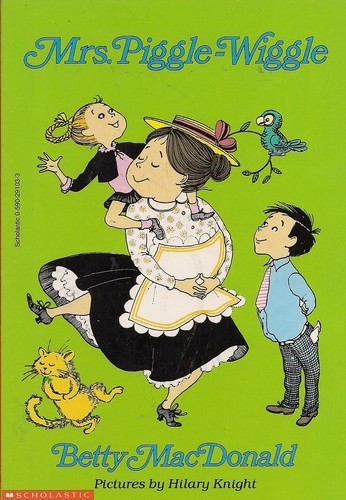
So you loved P. L Travers and/or Disney's Mary Poppins (yes, they're different), and your kids are begging for more. Enter: Betty MacDonald's Mrs. Piggle-Wiggle (text c. 1947, renewed 1975). And critically acclaimed artists Hilary Knight's pictures (illustrations c. 1957) and Alexandra Boiger's illustrations are a wonderful addition to MacDonald's charming text.
Betty MacDonald spun her stories first to her daughters' delight and then for the whole world to enjoy. As our publisher (Scholastic) accounts: Everyone loves Mrs. Piggle-Wiggle. She lives in an upside-down house and smells like cookies. She was even married to a pirate once. Most of all, she knows everything about children. She can cure them of any ailment. Patsy hates baths. Robert never puts anything away. Allen eats v-e-r-y slowly. Mrs. Piggle-Wiggle has a treatment for all of them.
Ages 6 to 10
And when you discover that you have reached the end of the book and the kids are still begging for more, don't fret, there's always: Mrs. Piggle-Wiggle's Magic, Hello, Mrs. Piggle-Wiggle, and Mrs. Piggle-Wiggle's Farm (illustrated by none other than Maurice Sendak)
This post is lovingly dedicated to all four of the Lewis children. Have a great week, friends!


Friday, June 22, 2012
Fancy Nancy
Here's a series of books that shows how an author paired with the right artist makes the book. Enter Fancy Nancy by Jane O'Connor and illustrated by Robin Preiss Glasser which debuted in picture book edition in 2005, with I Can Read books following in 2008 beginning with Fancy Nancy and the Boy from Paris.
What do we love about Fancy Nancy books here at Read Me A Story? Everything!!!
* Fancy Nancy teaches vocabulary while introducing various extensions of the sciences, arts, and natural world.
* Fancy Nancy loves anything and everything fancy (think frilly, prissy, etc.). She dresses up her vocabulary too, with "big words" and French words.
* The basic Fancy Nancy storyline goes something like: meaning well, Nancy Clancy ends up getting herself in a pickle of a predicament where an adult comes in to help her solve the problem and figure out a resolution.
* The messages in Fancy Nancy books promote good values of honesty, trust, friendship, etc.
* Personal testimony: the gals at my house simply ADORE Fancy Nancy!!!
* Professional testimony: O'Connor and Preiss Glasser's books have remained one of my #1 book recommendations since their debute in 2005. These are our favorite books to gift and recommend to girls everywhere!
So there you have it folks! I apologize that I'm just now getting to our beloved Fancy Nancy here in 2012. If you're not a fan, then what are you waiting for?! ;)
If you don't take my word for it, read this excellent recommendation: http://www.smartmompicks.com/a-well-spoken-and-well-adjusted-child-with-fancy-nancy-books/
While I don't have room to post all the Fancy Nancy book covers, I'll post our very favorites:
Friday, January 6, 2012
Owl at Home
![]() |
| title page |
You remember Arnold Lobel, right?! He's the creator of our dear friends Frog and Toad.
Well, you must, must, must check out this cozy and funny winter read, an I CAN READ book entitled Owl at Home by Arnold Lobel (c. 1975). Let me give you a glimpse of my favorite illustrations:
![]() |
| beginning the chapter entitled The Guest |
![]() |
| beginning the chapter entitled Tear-Water Tea |
Now, don't you just want to visit owl? You can! Owl at Home is especially perfect for your budding reader or for that young reader who wants an advancement. The kids just love Owl! Our house is filled with laughter whenever we read this together. To tell the truth, Owl is a bit daft, but his daftness evokes the frolicking laughs that children enjoy. I could go into a more thorough explanation of each of Lobel's five stories, but suffice it to say, Owl at Home is an experience you won't want to miss!
![]() |
| end cover |
Labels:
Ages 0-8,
Animals,
I Can Read,
Snow,
Tea time,
Winter,
Witty,
zz: Lobel-Arnold
Sunday, November 20, 2011
a Pumpkin Moonshine update:
Even though Halloween has passed. I just have to share this sweet little book by Tasha Tudor with you once again. You know, we all need our memories refreshed from time to time. And this little book remains an old friend. Just as good friends don't neglect each other, the dust jacket of Pumpkin Moonshine (c. 1938, renewed 1966) evidences love worn as its story becomes a familiar one. I don't think of it so much as a Halloween story as a late fall, November story. AND it's still in print!
So begins Tudor's charm:
Sylvie Ann was visiting her Grandmummy in Connecticut. It was Hallowe'en and Sylvie wanted to make a Pumpkin Moonshine, so she put on her bonnet and started out for the cornfield to find the very finest and largest pumpkin.
When they reached the field, Sylvie looked among the shocks of corn for the very fattest pumpkin. Way across the field she found such a fine one!Be sure to check out this delightful tale to discover what happens between the previous illustration and the following illustration. Of course, you'll want to read the ending too!
But worst of all it bumped right into Mr. Hemmelskamp who was carrying a pail full of whitewash!
Labels:
Ages 0-8,
Autumn,
Family,
Harvest,
Humorous,
New England,
Picture Book,
Pumpkin,
Witty,
zz: Tudor-Tasha
Sunday, November 13, 2011
Beatrix Potter's Autumn
Beatrix Potter teaches her young audience a few important (and humorous) lessons with her Autumn tales.
First she issues a warning through the example of Squirrel Nutkin (c. 1903).
While the squirrel clan harvests nuts into their storehouses,
Squirrel Nutkin teases and mocks Old Mr. Brown, the owl, with foolish riddles. We soon find that Nutkin can disrespect his elder only so much before Mr. Brown bites off his tail.
Then we come to Timmy Tiptoes (c. 1911).
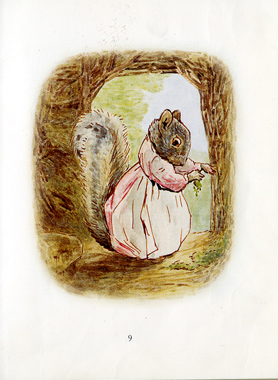
Here Timmy Tiptoes' wife Goody Tiptoes (I'm especially fond of this squirrel illustration) prepares her home for the winter.
Timmy and Goody work hard and fast to store nuts for their hibernation. Unfortunately, some other squirrels jump to conclusions, suspecting Timmy of stealing nuts.
And they punish Timmy by dropping him into a hollowed tree, unknowingly onto his own storehouse. While Goody searches for Timmy, Timmy gorges himself on nuts, so much so that he cannot escape through the hole once Goody finds him. Eventually circumstances right themselves, and Timmy and Goody reunite.
Last, but certainly not least, we have The Tale of Ginger and Pickles (c. 1909).
This story may be enjoyed by the parents more than the children, for it holds a timely commentary on our present economic atmosphere. For you see:
Ginger and Pickles gave unlimited credit. Now the meaning of "credit" is this --
when a customer buys a bar of soap, instead of the customer pulling out a purse and
paying for it -- she says she will pay another time. (19)
Yes, friends, this synopisis' irony will be lost on the little ones. We know the outcome of the story because we're living it. But to hear it so succinctly expressed by the prophetess Beatrix Potter deserves a second glance. If we had but heeded her warning! Perhaps reading this little volume to the ones under our care will help prevent similar outcomes in their future.
First she issues a warning through the example of Squirrel Nutkin (c. 1903).
While the squirrel clan harvests nuts into their storehouses,
Then we come to Timmy Tiptoes (c. 1911).
Here Timmy Tiptoes' wife Goody Tiptoes (I'm especially fond of this squirrel illustration) prepares her home for the winter.
Timmy and Goody work hard and fast to store nuts for their hibernation. Unfortunately, some other squirrels jump to conclusions, suspecting Timmy of stealing nuts.
And they punish Timmy by dropping him into a hollowed tree, unknowingly onto his own storehouse. While Goody searches for Timmy, Timmy gorges himself on nuts, so much so that he cannot escape through the hole once Goody finds him. Eventually circumstances right themselves, and Timmy and Goody reunite.
Last, but certainly not least, we have The Tale of Ginger and Pickles (c. 1909).
This story may be enjoyed by the parents more than the children, for it holds a timely commentary on our present economic atmosphere. For you see:
Ginger and Pickles gave unlimited credit. Now the meaning of "credit" is this --
when a customer buys a bar of soap, instead of the customer pulling out a purse and
paying for it -- she says she will pay another time. (19)
Yes, friends, this synopisis' irony will be lost on the little ones. We know the outcome of the story because we're living it. But to hear it so succinctly expressed by the prophetess Beatrix Potter deserves a second glance. If we had but heeded her warning! Perhaps reading this little volume to the ones under our care will help prevent similar outcomes in their future.
Thursday, September 22, 2011
Mouse and Mole
![]() |
| (c. 1993) |
We've made some new friends here at my house, friends whom the kids absolutely adore. And if it was possible, they'd invite them over for a snack and play date. Would you like to meet them too? Think of Mouse as a phlegmatic personality: rational, steady, kind, laid-back, and content. Now contrast him with Mole . . . ah, how to describe Mole. Well, he needs coddling. He's not the brightest bulb in the package. But he's endearing. And it's Mole's personality that drives the light humor in the Mouse and Mole tales, the delightful creation of author Joyce Dunbar and illustrator James Mayhew.
![]() |
| (c. 1996) |
The illustrations first won over the Mister and the Missus, and now we find ourselves saying to each other "Hello, Daffodil!" or "Meet Humphrey Stick." Yes, the illustrations made us stick around to hear the stories and to discover the illustrator: none other than James Mayhew, already a household favorite. You see, we first stumbled on Mouse and Mole courtesy of our dear friends Rich and Lori and the DVD they gave us. The only other time I've recommend that you check out or purchase a DVD was Beatrix Potter's Peter Rabbit series. So that should tell you something about the quality of this set of vignettes. Since each story is brief, you don't have to read (or watch) the entire book (or DVD) in one sitting, which makes for a wonderful bedtime collection and a wonderful collection for a maturing reader. And, my personal favorite, each vignette depicts a particular season, so when you've completed the whole series, you've experienced a spring, summer, autumn, and winter Mouse and Mole.
![]() |
| (c. 1993) |
I especially think that this review from Practical Parenting expresses the our affinity for Mouse and Mole: "Warm and witty illustrations . . . perfect to snuggle up with on a chilly afternoon."
![]() |
| (c. 1996) |
I also like the subtle character development in the Mouse and Mole series. Just read it! And you'll find yourself chuckling not only with the storyline but with the images they create. We all know a Mouse. And we all know a Mole. And we've experienced uncannily similar situations with each. I guess the best way to explain the series is likening it to a British version of our American friends Frog and Toad. In fact, the dedication of the first Mouse and Mole says "for dear old Frog and Toad" with the illustration of Mouse and Mole reading Frog and Toad books.
Note: I was grieved to discover that this wonderful series has fallen out of print. However, do check your local library, as ours holds the DVD collection. Also, I had no trouble acquiring the complete set from online bookstores. But please don't confuse them with a more recent collection listed under the same title yet written and illustrated by a completely different person.
Saturday, August 27, 2011
Are You My Mother?
Well, one of the children just surprised me by beginning Are You My Mother? (c. 1960) by P. D. Eastman. If your child is learning how to read, I encourage you to check out P. D. Eastman's books. They're quite a hit! In this particular story, a baby bird searches for his mother, interviewing the animals or machinery with whom he comes into contact. As his selections become odder and odder, the kids laugh harder and harder. Will baby bird ever find his mother?
P. D. Eastman is right up there with Dr. Seuss as far as I'm concerned. His sense of humor strikes just the right chord with the I Can Read age group. And he doesn't get mundane. In fact, it's a trip down memory lane reading (or listening) to these universally favorite reads.
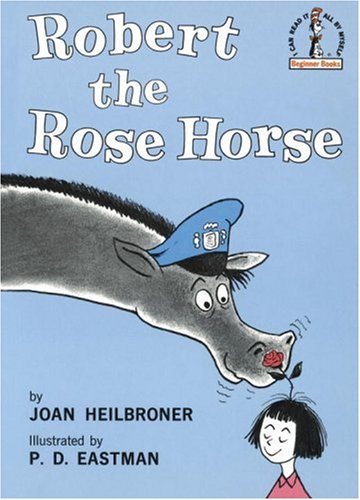
Recently, we borrowed Robert the Rose Horse (c. 1962) from our friends over at My Two Sons. Let me just tell you, this little story brings the house down with laughter! And everyone especially loves the surprise ending. However, it introduced a whole new problem. Yep, it's an I can't live without it favorite. So her kids moped about while we enjoyed it, and my kids moped about after we gave it back. Thank goodness Nana came to the rescue with Are You My Mother? So you know what I'm now on the look out for . . . more P. D. Eastman books!
P. D. Eastman is right up there with Dr. Seuss as far as I'm concerned. His sense of humor strikes just the right chord with the I Can Read age group. And he doesn't get mundane. In fact, it's a trip down memory lane reading (or listening) to these universally favorite reads.
Recently, we borrowed Robert the Rose Horse (c. 1962) from our friends over at My Two Sons. Let me just tell you, this little story brings the house down with laughter! And everyone especially loves the surprise ending. However, it introduced a whole new problem. Yep, it's an I can't live without it favorite. So her kids moped about while we enjoyed it, and my kids moped about after we gave it back. Thank goodness Nana came to the rescue with Are You My Mother? So you know what I'm now on the look out for . . . more P. D. Eastman books!
Wednesday, August 24, 2011
Tops & Bottoms
What happens when you mix a clever, determined Hare and a lazy, slothful Bear? A topsy turvy tale! As the publisher says:
With roots in European folktales and the slave stories of the American South, Tops & Bottoms celebrates the trickster tradition of beating hardship by using one's wits. And an acre of hilarity tops it all off!
Author and illustrator Janet Stevens masters the art of storytelling while exploring the artistic frontiers of childrens' book illustration. Stevens executes her illustrations by using watercolor, colored pencils, and gesso on paper made by hand by Ray Tomasso. In addition to the clever tale, the kids especially delighted in the way the story opens vertically, top to bottom.
So, hop on over to your local library to check out Tops & Bottoms (c. 1995), the perfect harvest time read.
Sunday, May 15, 2011
Piggins
What a delightful surprise! One of my favorite children's illustrators Jane Dyer has paired up with the highly acclaimed children's author Jane Yolen in a collaboration that has given us none other but Piggins (c. 1987). Piggins, the puzzle solving pig, adds skill and dexterity to his proper position as butler to the Reynard household.
Oh, yes, this is a children's mystery series in the spirit of Masterpiece Mystery. Set in the Edwardian Age, Piggins is said to be "a sophisticated English mystery parody for the primary set."
So check out the Piggins books for the children while Masterpiece Mystery runs their mystery series this summer. And see if the kids can figure out the mystery before Piggins. Rather unlikely, dear sir.
Subscribe to:
Comments (Atom)