Okay folks, I've learned some new things reading the kids' books. For one, did you know that John James Audubon disproved Aristotle's (and then current) scientific theory that birds don't fly underwater during winter . . . they migrate south. Now it seems downright silly to even imagine that people used to believe this as truth. But what is absolutely fascinating to my kids and me is that Audubon disproved the theory while he was a teen. Not only that, he recognized and copied bird calls and songs when he wasn't even in the "double-digits."
The kids were amazed by other stories of Audubon's life. In fact, we couldn't get enough of him. We kept searching for more books and more stories.
If you'd like to read some stories of wanderlust and adventure, you must check out both the childhood and adult stories of John James Audubon. And then after you've heard the tales of the talented artist / naturalist, check out the books with his very own, intricate bird illustrations. This has been a delightful exploration week at ReadMeAStory! I hope your family enjoys the biographies and illustrations as much as we have!
Here are some of our favorites:
Begin with The Boy Who Drew Birds: a story of John James Audubon by Jacqueline Davies and illustrated by Melissa Sweet (c. 2004), which Sweet beautifully illustrates herself, sometimes copying Audubon's field book, note-taking, sketching perspective.
Audubon: Painter of Birds in the Wild Frontier by Jennifer Armstrong and Jos. A Smith (c. 2003) presents three of our favorite WOW stories in Audubon's adulthood. This book presents Audubon as more of a Daniel Boone frontiersman and explorer than the other books did.
You may also want to check out:
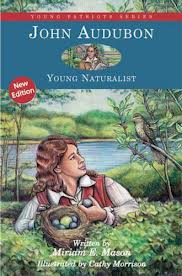
John Audubon: Young Naturalist by Miriam E Mason and Cathy Morrison (c. 2006) presents a great overview of Audubon's childhood and youth. I would recommend this book for 2nd - 4th grade readers. Although, we did find the illustrations a little odd.
One parent's (and her kids') guide to navigating the library and bookstore. My recommendations in children's book classics . . . literature for little ones, then and now.
Showing posts with label Science. Show all posts
Saturday, February 23, 2013
Sunday, February 10, 2013
The Great Backyard Bird Count!
I first heard about the bird count from Happy Homemaker UK in her post last year about the "Big Garden Birdwatch." I so desired to do our own bird count but couldn't find information on it anywhere . . . that is . . . until . . . this year! Those of us around here at ReadMeAStory cannot possibly wait until Friday, February 15, when the Great Backyard Bird Count begins.
So what's it all about?
From Feb. 15 through Feb. 18, folks across the nation will be spending at least 15 min. (or longer) a day watching the birds in their own backyard. We'll count, record, and report all the birds we see.
What's the point? Why?
(as copied exactly from http://www.birdsource.org/gbbc/whycount.html):
In other words:
We're participating in a science experiment by helping provide research and statistics for the National Audubon Society's various bird studies, including bird migratory patterns. So by participating only 15 min. a day, we're contributing to legitimate research!
Some of our favorite birdwatching books around here at ReadMeAStory include:
COUNTING is for the Birds by Frank Mazzola, Jr. (c. 1997) covers several developmental skills all at once. While teaching your child to count to twenty, Mazzola introduces rhyme, bird facts, number recognition, bird species identification, all while weaving together a hidden plotline.
The kids' very favorite bird identification guide is The Pocket Naturalist Guide: South Carolina Birds: An Introduction to Familiar Species (State Nature Guides) [Pamphlet] by James Kavanagh (c. 2002). Read more about this resource on my post about The Pocket Naturalist Guides
Our Yard is Full of Birds (c.1992) by the mother daughter team Anne & Lizzy Rockwell tells a boy's story of bird watching while identifying various species of birds. Lizzy Rockwell's watercolor and pencil illustrations beautifully capture each bird's unique traits.
So what's it all about?
From Feb. 15 through Feb. 18, folks across the nation will be spending at least 15 min. (or longer) a day watching the birds in their own backyard. We'll count, record, and report all the birds we see.
What's the point? Why?
(as copied exactly from http://www.birdsource.org/gbbc/whycount.html):
Scientists and bird enthusiasts can learn a lot by knowing where the birds are. Bird populations are dynamic; they are constantly in flux. No single scientist or team of scientists could hope to document and understand the complex distribution and movements of so many species in such a short time.
The longer these data are collected, the more meaningful they become in helping scientists investigate far-reaching questions, like these:
• How will the weather influence bird populations?
• Where are winter finches and other “irruptive” species that appear in large numbers during some years but not others?
• How will the timing of birds’ migrations compare with past years?
• How are bird diseases, such as West Nile virus, affecting birds in different regions?
• What kinds of differences in bird diversity are apparent in cities versus suburban, rural, and natural areas?
• How will the timing of birds’ migrations compare with past years?
• How are bird diseases, such as West Nile virus, affecting birds in different regions?
• What kinds of differences in bird diversity are apparent in cities versus suburban, rural, and natural areas?
The Great Backyard Bird Count is led by the Cornell Lab of Ornithology and National Audubon Society, with Canadian partner Bird Studies Canada and sponsorship from Wild Birds Unlimited.
In other words:
We're participating in a science experiment by helping provide research and statistics for the National Audubon Society's various bird studies, including bird migratory patterns. So by participating only 15 min. a day, we're contributing to legitimate research!
Some of our favorite birdwatching books around here at ReadMeAStory include:
COUNTING is for the Birds by Frank Mazzola, Jr. (c. 1997) covers several developmental skills all at once. While teaching your child to count to twenty, Mazzola introduces rhyme, bird facts, number recognition, bird species identification, all while weaving together a hidden plotline.
The kids' very favorite bird identification guide is The Pocket Naturalist Guide: South Carolina Birds: An Introduction to Familiar Species (State Nature Guides) [Pamphlet] by James Kavanagh (c. 2002). Read more about this resource on my post about The Pocket Naturalist Guides
Our Yard is Full of Birds (c.1992) by the mother daughter team Anne & Lizzy Rockwell tells a boy's story of bird watching while identifying various species of birds. Lizzy Rockwell's watercolor and pencil illustrations beautifully capture each bird's unique traits.
Tuesday, October 2, 2012
Count Down to Fall
If your child is an animal lover, here's a book with detailed animal illustrations. Count Down to Fall (c. 2009) with author Fran Hawk and illustrator Sherry Neidigh teaches about various trees, leaves, seeds, and animals. Note: I love the illustrations but find the text somewhat lacking. However, the end pages presents good natural science information.
Tuesday, September 4, 2012
Nature's Notes
Remember when I raved over The Secret Life of Backyard Bugs? Well, this is Judy Burris' and Wayne Richards' latest book: Nature's Notes: Bite-sized Learning and Projects for All Ages
(c. 2012). And I've had a tough time trying to review it for the past 2-3 weeks because the kids won't let it out of their sight!
The title Nature's Notes best explains this 6.25"x8.25" (perfectly kid-sized) spiral-bound book. Each chapter is filled with nature trivia and coinciding projects, such as:
Think of it as a kid's hand-held, printed version of Pinterest. There's even lined pages and sketch pages provided in the back for kids to record their own observations. I also like the folder-like, pocket-flap in the front to hold additional papers, leaves, pressed flowers, etc.
But I especially like how the like-minded authors of Nature's Notes
Can my young readers spot the hidden animals (there are three)?
(c. 2012). And I've had a tough time trying to review it for the past 2-3 weeks because the kids won't let it out of their sight!
The title Nature's Notes best explains this 6.25"x8.25" (perfectly kid-sized) spiral-bound book. Each chapter is filled with nature trivia and coinciding projects, such as:
- how to best photo nature
- how to make hummingbird food
- how to distinguish poison ivy
- how take care of a caterpillar until it turns into a butterfly
But I especially like how the like-minded authors of Nature's Notes
- encourage kids to find beauty throughout creation by observing and experiencing the natural world around them and
- spur kids' innate curiosity through hands-on activities and age-appropriate direction.
So check Nature's Notes out for yourself. Just make sure you have time to look over it before the kids get ahold of it!
Can my young readers spot the hidden animals (there are three)?
***These book images are all used curtesy of the authors' blog: http://www.beautifulwildlifegarden.com/ ***
Sunday, July 29, 2012
Magic Tree House #16: Hour of the Olympics
The Magic Tree House books Dinosaurs Before Dark debuted 20 years ago yesterday, on July 28. Since then author Mary Pope Osborne and illustrator Sal Murdocca have taken her readers on forty-seven more adventures with Jack and Annie. The forty-eighth adventure A Perfect Time for Pandas just hit bookseller's shelves on July 24, 2012.
If your kids haven't gotten into The Magic Tree House craze yet, we suggest you check out a few books, which are easily available at local libraries, used book stores, consignment stores, and local bookstores. There's something for everyone in this series, whether you like science, history, culture, art, fantasy, etc. You name it, if your child doesn't find a book in this series that he/she likes, then he/she isn't trying! Mary Pope Osborne's adventures are perfect for budding readers! I guarantee you, your child won't want to put down these page turners!
And for this Olympic season, try: Magic Tree House #16: Hour of the Olympics
And also check it's nonfiction companion book: Magic Tree House Fact Tracker #10: Ancient Greece and the Olympics
Friday, July 27, 2012
The Fantastic Undersea Life of Jacques Cousteau
Wow! That's all I can say . . . WOW! This book is spellbinding.
First of all, it taught me about the man behind that ocean camera, Jacques Cousteau. I remember watching him in my childhood, but, of course, I didn't know his bio.
Author/illustrator Dan Yaccarino (c. 2009) captures the wonder that lead Cousteau into ocean exploration and transports his readers into the fanciful water-dimmed world of Oceanic life.
Oh . . . and the kids loved it too!!!
Friday, June 22, 2012
Fancy Nancy
Here's a series of books that shows how an author paired with the right artist makes the book. Enter Fancy Nancy by Jane O'Connor and illustrated by Robin Preiss Glasser which debuted in picture book edition in 2005, with I Can Read books following in 2008 beginning with Fancy Nancy and the Boy from Paris.
What do we love about Fancy Nancy books here at Read Me A Story? Everything!!!
* Fancy Nancy teaches vocabulary while introducing various extensions of the sciences, arts, and natural world.
* Fancy Nancy loves anything and everything fancy (think frilly, prissy, etc.). She dresses up her vocabulary too, with "big words" and French words.
* The basic Fancy Nancy storyline goes something like: meaning well, Nancy Clancy ends up getting herself in a pickle of a predicament where an adult comes in to help her solve the problem and figure out a resolution.
* The messages in Fancy Nancy books promote good values of honesty, trust, friendship, etc.
* Personal testimony: the gals at my house simply ADORE Fancy Nancy!!!
* Professional testimony: O'Connor and Preiss Glasser's books have remained one of my #1 book recommendations since their debute in 2005. These are our favorite books to gift and recommend to girls everywhere!
So there you have it folks! I apologize that I'm just now getting to our beloved Fancy Nancy here in 2012. If you're not a fan, then what are you waiting for?! ;)
If you don't take my word for it, read this excellent recommendation: http://www.smartmompicks.com/a-well-spoken-and-well-adjusted-child-with-fancy-nancy-books/
While I don't have room to post all the Fancy Nancy book covers, I'll post our very favorites:
Friday, June 15, 2012
A Butterfly is Patient
In this rush ridden world, with instant food, money, conversation, etc., patience hardly seems a virtue. Don't you sometimes feel like you're running against the grain as you try to teach those little people the art of waiting?
Please, let me introduce you to this brilliantly beautiful book that weaves science with the art of patience. And while I think that author Dianna Hutts Aston's years are a few millinia off, I also think that A Butterfly is Patient (c. 2011) is a book you'll want to check out, take a look at, and read together with your child.
And the added bonus is that Sylvia Long's watercolors are absolutely spellbinding! Her images render the lifecycle of a butterfly as looking through a magnifying glass. Take a look:
Saturday, April 14, 2012
The Secret Lives of Backyard BUGS
It's spring, and we've been spending most of our time outside. The kids have been chasing butterflies, climbing trees, and playing with bugs! Thanks to our friend Caleb, we've enjoyed seeing baby Praying Mantis that had just hatched out of a pod-like house. Now they watch three caterpillars (that Momma has been keeping alive for several weeks!) in hopes to see evolve from chrysalis to butterfly (fingers crossed).
Needless to say they've all been quite keen on identifying these various creatures. So we've needed a little help (to say the least) from written sources.
So I dedicate this post to all my "bug" lovin' young friends. Here's the book that the kids have monopolized for the past few days. I recommend The Secret Lives of Backyard BUGS by Judy Burris and Wayne Richards to friends of all ages. The photos are phenomenal! The explanations are just long enough to inform and just short enough to keep a child's attention span.
The Secret Lives of Backyard BUGS explores insects of all varieties, from beetles to wasps and icky stink bugs to beautiful butterflies. Including life cycles and quick guides while identifying host plants, this book presents it all in a simple, easy-to-read format (I know that sounds like a contradiction, but you'll have to trust me!). Each page has just enough information and pictures to inform without overwhelming the reader's senses.
And I've learned quite a bit along the way too! I thought all dragonflies were alike. Au contraire my friends, enter the damselfly. If you'd like to know the difference, be sure to check out The Secret Lives of Backyard BUGS. Your kids will thank me!Update: we watched two of our caterpillars make cocoons!
Tuesday, January 31, 2012
It's Snowing!
We've found a new book, new because it was just published in 2011. It's Snowing by Gail Gibbons presents the science behind snowfall, drawing children in with her bright illustrations and maps.
What I especially like about Gail Gibbons easy to understand account is that she credits the National Weather Service and their meteorologists for her spot-on information. Yep, around here, we think VERY highly of the National Weather Service. We only get our weather information from http://weather.noaa.gov/ or http://weather.gov/ or NOAA Weather Radio (http://www.nws.noaa.gov/nwr/). Traveling? Then plan your trip by the National Weather Service's forecasts.
Looking for accuracy and expertise, then I encourage you to check out the National Weather Service as opposed to weather.com. Seriously, the statistics are the proof. And we may be a tad bit biased toward meteorologists; after all, Papa Terry did just retire from NWS.
Either way, Gail Gibbons gives an excellent, spot-on account explaining how snow forms, the different forms of winter precipitation, and how to prepare for winter weather. Check out It's Snowing! by Gail Gibbons, or purchase it from the recent Scholastic handouts. It's well worth the effort! For my part, I plan on purchasing our own copy.
Labels:
Ages 0-8,
Picture Book,
Science,
Snow,
Weather,
Winter,
zz: Gibbons-Gail
Sunday, January 9, 2011
Snowflake Bentley
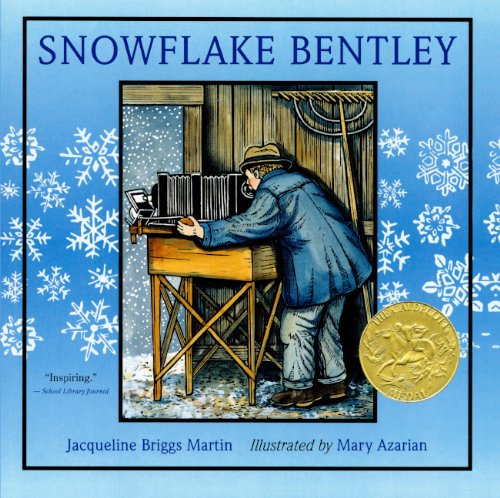
Dear reader, this is the time of year to check out the 1999 Caldecott Medal book Snowflake Bentley (c 1998), not only for Mary Azarian's award winning woodcuts "handtinted with watercolors" but also for the intriguing history lesson / biography by Jacqueline Briggs Martin of the man who gave us the first close-ups of a snowflake. Find out about Wilson Bentley's passion for snow and perseverance to discover a way to photograph snowflakes.
Here's a portion of the publisher's book review:
"Often misunderstood in his time, Wilson Bentley took pictures that even today reveal two important truths about snowflakes: first, that no two are alike, and second, that each one is startlingly beautiful."
And while the publishers recommend this particular picture book to ages 4-8, the history lesson is presented in such a beautiful way that you really should have your eldest children read it to their younger siblings. Then, for those older siblings, check out Snow Crystals and/or Snowflakes in Photographs both by W. A. Bentley himself.

All ages will especially like looking through the original photographs of MANY individual snowflakes. Afterwards, feel free to make your own snowflakes, as we did, using Lauren Stringer's tutorial (in correlation to her previously posted book, Snow).
Happy snow day!
Here's a portion of the publisher's book review:
"Often misunderstood in his time, Wilson Bentley took pictures that even today reveal two important truths about snowflakes: first, that no two are alike, and second, that each one is startlingly beautiful."
And while the publishers recommend this particular picture book to ages 4-8, the history lesson is presented in such a beautiful way that you really should have your eldest children read it to their younger siblings. Then, for those older siblings, check out Snow Crystals and/or Snowflakes in Photographs both by W. A. Bentley himself.

All ages will especially like looking through the original photographs of MANY individual snowflakes. Afterwards, feel free to make your own snowflakes, as we did, using Lauren Stringer's tutorial (in correlation to her previously posted book, Snow).
Happy snow day!
Subscribe to:
Comments (Atom)