Showing posts with label History. Show all posts

Monday, December 17, 2012

Good King Wenceslas

Do you know what I love about this season?  I love:
  • packing our Operation Christmas Child boxes
  • selecting gifts in the Samaritan's Purse Gift Catalog with the kids
  • hearing the Salvation Army bells ring, 
  • reading all the charity benefit concerts, dinners, raffles, etc. being held, 
  • hearing of opportunities to take dry goods or meals to shut-ins, and 
  • discovering different opportunities to donate time and/or funds to help the less fortunate.  
Seriously, if you're not giving something of yourself during this season, it's certainly not from lack of opportunity!


So during this season of "Peace on earth, goodwill to men," King Wenceslas stands out as a model.  You're familiar with the traditional carol, but do you know its origin?  Well, the story of Good King Wenceslas shows us the purpose and the motive behind such benevolent, seasonal giving.  John Mason Neale, an English Anglican priest, wrote the words to the carol "Good King Wenceslas" in 1853, for the feast following Christmas Day called Saint Stephen.  Tradition holds that Neale derived his inspiration from actual events influenced by the just-minded and kindhearted King Wenceslas, ruler of tenth century Bohemia or the present day Czech Republic.  In fact, a statue of King Wenceslas, or now Saint Wenceslas, stands in Wenceslas Square in Prague.  (For photos of that statue, look at http://wemsha.blogspot.com/2010/06/wenceslas-square-prague.html).

Check out this fascinating book Good King Wenceslas (c. 2005), which looks at the story behind the inspiration of the carol.  Tim Ladwig's remarkable illustrations give us a modern peak into the past.  And be sure to take longer than a passing glance at that last illustration.

Sunday, July 29, 2012

Magic Tree House #16: Hour of the Olympics


The Magic Tree House books Dinosaurs Before Dark debuted 20 years ago yesterday, on July 28.  Since then author Mary Pope Osborne and illustrator Sal Murdocca have taken her readers on forty-seven more adventures with Jack and Annie. The forty-eighth adventure A Perfect Time for Pandas just hit bookseller's shelves on July 24, 2012.


If your kids haven't gotten into The Magic Tree House craze yet, we suggest you check out a few books, which are easily available at local libraries, used book stores, consignment stores, and local bookstores.  There's something for everyone in this series, whether you like science, history, culture, art, fantasy, etc.  You name it, if your child doesn't find a book in this series that he/she likes, then he/she isn't trying!  Mary Pope Osborne's adventures are perfect for budding readers!  I guarantee you, your child won't want to put down these page turners!

And for this Olympic season, try: Magic Tree House #16: Hour of the Olympics


And also check it's nonfiction companion book: Magic Tree House Fact Tracker #10: Ancient Greece and the Olympics

Friday, July 27, 2012

The Fantastic Undersea Life of Jacques Cousteau


Wow!  That's all I can say . . . WOW!  This book is spellbinding.  

First of all, it taught me about the man behind that ocean camera, Jacques Cousteau.  I remember watching him in my childhood, but, of course, I didn't know his bio.  

Author/illustrator Dan Yaccarino (c. 2009) captures the wonder that lead Cousteau into ocean exploration and transports his readers into the fanciful water-dimmed world of Oceanic life.


Oh . . . and the kids loved it too!!!

Thursday, June 21, 2012

Iron Horses

Dedicated to all my train-loving readers: Have you ever wandered how the transcontinental railroad was built?  "Transcontinental Railroad?" you ask.  It was the joining of the American west's Central Pacific Railroad to the east's Union Pacific Railroad so that citizens could travel from one coast to the next in a matter of days rather than months.

Discover this train race afresh with Verla Kay's simple rhyming text and Michael McCurdy's signature illustrations in Iron Horses (c. 1999).

Monday, April 9, 2012

When Marian Sang


It was her range of notes
that caused all the commotion.
With one breath she sounded like rain,
sprinkling high notes in the morning sun.
And with the next she was thunder,
resounding the deep in a dark sky. (Ryan) 

As this Lenten Season comes to a close, I recommend the moving bio of Marian Anderson called When Marian Sang written by Pam Munoz Ryan and illustrated by Brian Selznnick (c. 2002).  Our library includes the audio recording, making it a spellbinding experience to hear Anderson as she sings in that majestic contralto voice . . . her voice was distinct -- strong and velvety and able to climb more than twenty-four notes (Ryan).

Listen to one of America's greatest singers; listen and be moved by the story of Marian Anderson, accompanied by her remarkable voice singing songs ranging from spirituals to opera.


Marian Anderson singing at the Lincoln Memorial on Easter Sunday, April 9, 1939

Wednesday, March 14, 2012

Dave the Potter


Artist, Poet, Slave

Read Dave the Potter by Laban Carrick Hill, illustrated by Bryan Collier (c. 2010)
and discover a POWERFUL story based on none other than Dave, the potter.

Monday, January 16, 2012

Martin's Big Words

Doreen Rappaport weaves together her words and Dr. King's words in the Caldecott honor book, illustrated by Bryan Collier, Martin's Big Words: The Life of Dr. Martin Luther King, Jr. (c. 2001).
 
Martin said 'love'
when others said 'hate.'

'Hate cannot drive out hate.
Only love can do that.'

Monday, November 21, 2011

The First Thanksgiving


I've introduced the magnificent paintings of Thomas Locker to you.  Here's his take on The First Thanksgiving written by Jean Craighead George (c. 1993).

Wednesday, October 19, 2011

Tuttle's Red Barn


Tuttle's Red Barn: The Story of America's Oldest Family Farm 
by Richard Michelson
Illustrated by Mary Azarian
copyright 2007

We stumbled upon this dear book, and even the kids sat through the whole long family tree of a story.  I'd sit here and chatter on about it for hours, but really, the publisher G.P. Putnam's Sons did such a fabulous job with its jacket leaf write-up that I won't reinvent the wheel in saying anymore:

The story of Tuttle's Red Barn is the story of America.  John Tuttle arrived in Dover, New Hampshire, in 1632 with only his father's ax an the two pewter candleholders his mother had given him after they'd hugged good-bye.  But from that humble beginning he built the farm that, today, still stands on the same land.

Twelve generations have tilled this New England soil, taking part in many great milestones of American history along the way.  The Tuttle family fought in the Revolutionary War, protected slaves on the Underground Railroad, and helped pave the way for the Industrial Revolution.  A Tuttle was even there to offer maple syrup to Abraham Lincoln when he visited Dover!

A fascinating look at America as seen through the eyes of one family, Tuttle's Red Barn is a must-read for anyone who appreciates the story of our country.  Caldecott medalist Mary Azarian's vibrant woodcut illustrations accompany Richard Michelson's informative and remarkable account of one family that has stayed connected through the centuries by a love of family, and one big red barn.

And if you'd like to see Tuttle's present day red barn and surrounding landscapes, here are some links:
http://www.flickr.com/photos/catchesthelight/3488876560/
http://richardmichelson.com/tuttle/book-release.html

Here's a fascinating interview with the illustrator, Mary Azarian:
http://richtexts.blogspot.com/2011/09/green-mountain-magic.html

Monday, October 10, 2011

Ox-Cart Man


Do you remember this book?  I think I first discovered it via Reading Rainbow as LeVar Burton read it to his audience.  Ox-Cart Man (c. 1979) by Donald Hall with Caldecott award winning illustrations by our beloved Barbara Cooney recalls the days of a 19th century New England family.  Take a journey back in time from the moment you open the first page:

                                           In October he backed his ox into his cart
                                           and he and his family filled it up
                                          with everything they made or grew all year long
                                          that was left over.


A beautiful depiction of early settler life throughout the seasons, Ox-Cart Man takes the ten day travel to town to trade his goods for the necessities for surviving the next year on his family farm.

Monday, July 4, 2011

The Star-Spangled Banner


When I was a little girl, my favorite holiday was the 4th of July.  Looking back, I'm trying to remember if it beat out Christmas, or if it was a neck and neck holiday tie.  Probably both.  I loved 4th of July picnics, eating juicy, beefy hamburgers slathered in ketchup, mustard, and pickles.  I loved spending time with family, singing patriotic songs, waving American flags, and listening to bands play the national anthem.  But the highlight came after sundown, when the sky lit up with the brilliant sparkles and various colors of fireworks.  I sat mesmerized by the glorious sight, trying to decide which showstopper was my favorite . . . each display exceeding the last . . . and all of them magically synchronized to a patriotic soundtrack.


Take all of this, and imagine the inspiration of our national anthem birthed out of heavy shelling and rocketing bombs.  It happened during the War of 1812, when the British bombarded Baltimore's Fort McHenry for a twenty-five hour stint.  Frances Scott Key penned these resonating words when he spotted our American flag gloriously waving out of the smog and battle's fray.  From the unfurling of that "Star-Spangled Banner" raised over Fort McHenry, we Americans gained a national anthem.  Check out Peter Spier's superb depiction of history in his illustrated book The Star-Spangled Banner (c. 1973).  Spier illustriously represents each stanza of the anthem and provides a concise history in the appendix.

You may also enjoy Peter Spier's We the People: The Constitution of the United States of America (c. 1987). And have a happy 4th of July, dear readers!

Sunday, July 3, 2011

America the Beautiful


Wendell Minor took my breath away with America the Beautiful (c. 2003).  WOW!  There have been very few books that have left me speechless after I've read them.  This is one of them.  At the same time that it left me speechless, it left my heart swelling with pride to be an American.  Minor's watercolor paintings are breathtaking.  From the Kennedy Space Center in Cape Canaveral, Florida to Heceta Head, Oregon and Yosemite National Park in California to Falmouth Massacusetts, each spread represents a specific region or state in our country, perfectly paired with each verse in this unforgettable anthem.  Minor also provides the fascinating story behind Katharine Lee Bates' poem turned song, complete with concise biographies.  Minor's book reflects our countries majestic landscape in his masterpieces as well as carefully researched text in the appendices.  A jewel to share with your children, don't neglect to check out this brilliant book.

Wednesday, March 2, 2011

Black History Month

I feel a bit like I'm playing catch up.  I've checked out many, many books from our local library, celebrating Black History Month . . . which was in February . . . and now it's March.  I'd say I'm behind!  Allow me to share with you the three books that continue to draw me back:


Through My Eyes by Ruby Bridges herself was perhaps the most moving of all three titles because it gave the most heart-wrenching account of the days of the Civil Rights Movement.  It took me several days before my mind would rest from what I read of Ruby Bridges' (and her teacher, Mrs. Barbara Henry) story.  The suggested ages for this title are 8-12.


David A. Adler is renown for his biographies for children for a reason.  Dr. Martin Luther King, Jr., proves no exception.  I especially liked illustrator Colin Bootman's interpretation of the historic events retold in this book.  From the Holiday House Reader, this level 2 volume is suggested for ages 4-8.
The review on the inside dust jacket of Rosa Parks best describes the book: "David A. Adler's Picture Book Biographies have been hailed as an 'expert mixture of facts and personality' (School Library Journal)."  Rosa Parks is suggested for grades K through 4th.

Monday, February 21, 2011

Happy President's Day!

Here are some brief recommendations before the close of the day.  A fun book for the younger ones, Anne and Lizzy Rockwell team up again to present this introduction to President's Day through the venue of a classroom play.


We really like David A. Adler's Picture Book Biography series!  Adler goes beyond the presidents with his biographies.  However, today I recommend his George Washington, John and Abigail Adams, Thomas Jefferson, Dolley and James Madison, and Abraham Lincoln.  These stories are best suited for children ages 4-8.  

Sunday, January 9, 2011

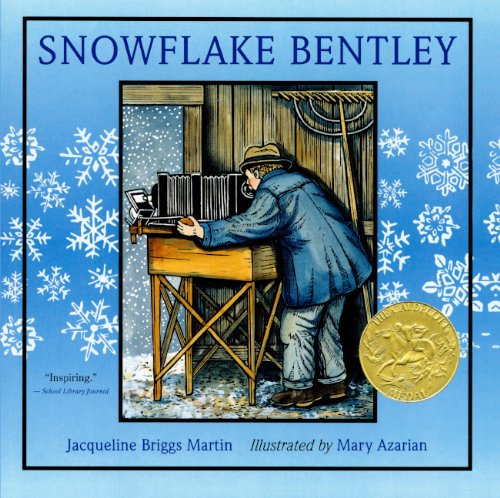
Snowflake Bentley

Dear reader, this is the time of year to check out the 1999 Caldecott Medal book Snowflake Bentley (c 1998), not only for Mary Azarian's award winning woodcuts "handtinted with watercolors" but also for the intriguing history lesson / biography by Jacqueline Briggs Martin of the man who gave us the first close-ups of a snowflake.  Find out about Wilson Bentley's passion for snow and perseverance to discover a way to photograph snowflakes.


Here's a portion of the publisher's book review:
"Often misunderstood in his time, Wilson Bentley took pictures that even today reveal two important truths about snowflakes: first, that no two are alike, and second, that each one is startlingly beautiful."

And while the publishers recommend this particular picture book to ages 4-8, the history lesson is presented in such a beautiful way that you really should have your eldest children read it to their younger siblings.  Then, for those older siblings, check out Snow Crystals and/or Snowflakes in Photographs both by W. A. Bentley himself.


All ages will especially like looking through the original photographs of MANY individual snowflakes.  Afterwards, feel free to make your own snowflakes, as we did, using Lauren Stringer's tutorial (in correlation to her previously posted book, Snow).

Happy snow day!

Wednesday, January 5, 2011

The Twelve Days of Christmas

In closing out the Christmas season in true traditional form, and since it's the eve of the 5th, Twelfth Night, and most likely you'll be reading this close to January 6th, Twelfth Day, I'd like to share with you our latest.  This year, Nana gifted The Twelve Days of Christmas, and I'm just wild about the edition she chose, the most beautiful one out there, by Gennady Spirin.  Now what I find most fascinating about illustrator Gennady Spirin is not that he grew up near Moscow nor that he received five golden medals (sorry, I just had to) from various artistic societies nor that he is now a U.S. citizen.  Indeed, I find most interesting that Spirin was born on Christmas Day.  Now do you think this detail lends to the brilliant composition of his Christmas books?  I can't help but attribute the likelihood.


What also came as a surprise to me was Spirin's medium: watercolor and colored pencil.  His illustrations reflect the boldness and brilliance of the Renaissance, not at all reflective of typical watercolor scenes.  Unbeknowst to Nana, I had checked out all the editions of The Twelve Days of Christmas that our library offered, without finding a copy that met my expectations.  Gennady Spirin presented a pleasant surprise because what I like best about this edition is that it's how I envision the carol to be illustrated in accordance with it's history.  Thank you Mr. Spirin!  I'm discovering Gennady Spirin's books to be rare gems with illustrations to feast your eyes upon.

Now for a little history on this "Twelve Days of Christmas" song that the kids beg to be repeated but that we parents would personally rather hit "skip" for the rest of our lives.  Hold that impulse!  Before you hit "skip" for the up-teenth time, be forewarned: it appears our predecessors understood the importance of repetition and memory games long before medical research journals informed us of modern day benefits.
  • Yes, "The Twelve Days of Christmas" seems to have originated as a memory game that children played on Twelfth Night, wherein whoever forgot the line that fell to them had to forfeit a possession.
  • In 1780, "The Twelve Days of Christmas" manifested in print for the first time in an English children's book entitled Mirth Without Mischief.
  • Twelfth Night traditionally occurred on the night of December 5th with Twelfth Day following on December 6th.  
  • The twelve days following Christmas Day held great festivities during the Middle Ages up until the nineteenth century, with the grand celebration on Twelfth Night serving as the culmination of all preceding revelry (further construing the title of Shakespeare's play Twelfth Night, wherein the festivity serves as a springboard for a comedy aimed at merrymaking, folly, and masquerade).  
  • In historical church order, Twelfth Day marks the Epiphany, the day marking when the Magi offered their gifts of gold, frankincense, and myrrh to the Christ child.  
Whew! and to think I cut out much, much more historical information from that summary, which is clearly more for you parents' benefit.

So the next time the kids want to listen to "The Twelve Days of Christmas" over and over, just plop them down with Spirin's book and consider the activity as memory and counting enhancement without any work on your part.

Friday, December 24, 2010

I Heard the Bells on Christmas Day


 "Christmas Bells" or
"I Heard the Bells on Christmas Day"
by Henry Wadsworth Longfellow
(The original poem, complete with all seven stanzas)

I heard the bells on Christmas Day
Their old familiar carols play,
And wild and sweet
The words repeat
Of peace on earth, good-will to men!


And thought how, as the day had come,
The belfries of all Christendom
Had rolled along
The unbroken song
Of peace on earth, good-will to men!


Till, ringing, singing on its way,
The world revolved from night to day,
A voice, a chime
A chant sublime
Of peace on earth, good-will to men!


Then from each black accursed mouth
The cannon thundered in the South,
And with the sound
The carols drowned
Of peace on earth, good-will to men!


It was as if an earthquake rent
The hearth-stones of a continent,
And made forlorn
The households born
Of peace on earth, good-will to men!


And in despair I bowed my head;
"There is no peace on earth," I said;
"For hate is strong,
And mocks the song
Of peace on earth, good-will to men!"


Then pealed the bells more loud and deep:
"God is not dead; nor doth he sleep!
The Wrong shall fail,
The Right prevail,
With peace on earth, good-will to men!"


Henry Wadsworth Longfellow experienced great devastation in 1861, but out of that overwhelming grief, he began to pen the words that would lead him to write this unforgettable poem, which he completed in 1864. To read the heart-wrenching story behind the poem -- now Christmas carol -- check out: http://hubpages.com/hub/The-story-behind-I-Heard-the-Bells-on-Christmas-Day 


or check out this beautiful book by Lloyd Newell and Karmel Newell that contains Longfellow's poem and story.  Merry Christmas!


Sunday, December 19, 2010

This Is the Stable

  
This Is the Stable by Cynthia Cotten tells the miracle of Jesus' birth in the rhythm of This is the House that Jack Built, making it catchy for children to remember the detailsArtist Delana Bettoli "used sepia ink outline, watercolor underpainting, gouache, and acrylic paint to create" her illustrations.

This is such a departure from the nativities we've seen in the past.  Finally, Bettoli presents us with a Mary, Joseph, baby Jesus, and shepherds that look like they're from Israel.  And how about these wise men who could actually be from the Eastern Hemisphere.


 As you can see, Bettoli's brilliant artwork makes this book stand out from other nativity editions.  I have to catch my breath each time I come to this page.  Isn't the rich color she gives to the angels just spectacular?  Bettoli's interpretation of the brilliancy of light and color of the angels encompassing the sky lends us understanding as to why the shepherds were fearful.


But what I love about this book most of all are dove-like wings enveloping the sky and stable, which for me signifies God's presence.  In fact, look for the dove throughout the story -- a Biblical symbol of God's Spirit.

Sunday, December 12, 2010

The Christmas Story

Let me start off by saying that Eloise Wilkin is one of my all-time favorite illustrators for young children.  I grew up reading and re-reading her books.  I remember studying her illustrations for hours upon hours.  I find my children doing the same. You absolutely cannot go wrong when you pick up one of her books.  If you see a Wilkin book, get it!  And if you don't want it, by all means, send - it - to - me!!  (I could easily become a hoarder in this arena.)  I mean just look at those precious faces she captures.  I could blog for months and months about specific Wilkin titles, every one of them so dear. 

However, this evening, I'm going to feature Jane Werner's narrative of The Christmas Story (c. 1952) that Wilkin illustrates.  Oh, the joy of flipping through this book.  The Nativity steps off its display and into a picture book well suited for young children.  Werner stays true to the original Biblical text, using specific quotations from scripture, in her retelling of the Jesus' immaculate birth.  Eloise Wilkin's characteristic illustrations help modern day children envision that ancient miracle.


Unfortunately, our local library doesn't have this particular edition.  However, I've yet to come across a bookstore who doesn't carry it.  I've also seen it in some random places like Hobby Lobby and the Dollar Store.

Monday, December 6, 2010

Little House in the Big Woods

We're reading out of Little House in the Big Woods right now, and I'm telling you, there's nothing like cuddling up with your kids during those cold winter evenings and reading this classic by Laura Ingalls Wilder.  I distinctly remember my own mother gathering us together on cold winter nights to read (in the large print text) about the wolves howling underneath the great Minnesota winter moons, Pa's hog butchering to feed his family through the bitterest of months, and the aunts and uncles dancing at Grandpa's.

You well know this time-worn classic of a pioneer family's life.  It's time to revisit it again from the viewpoint of a parent reading it to the next generation.  And if you do decide to make it your winter tradition to read Little House in the Big Woods aloud to your family, try to check out that special large print edition!


You know, I've often wondered if the classic Little House on the Prairie series would have the same intense popularity that it does if it wasn't for Garth Williams' beloved illustrations -- the author and illustrator compliment each other so well!  I thought this quotation from the Harper Collins website was well worth repeating: Garth Williams began his work on the pictures for the Little House books by meeting Laura Ingalls Wilder at her home in Missouri, and then he traveled to the sites of all the little houses. His charming art caused Laura to remark that she and her family "live again in these illustrations."

If you're interested in follow-up projects and books, check out the official website: http://www.littlehousebooks.com/