Showing posts with label Ages 8-13. Show all posts

Tuesday, December 3, 2013

The Best Christmas Pageant Ever

Would you like a fresh look at that very first Christmas?  If so, I recommend looking at Barbara Robinson's The Best Christmas Pageant Ever and rediscovering Christmas through the eyes of the Herdmans.

The Herdmans?!!! you ask.  Aren't they the kids who dodge a banging garage door for fun?  Aren't they the kids who burned down Fred Shoemaker's shed?  Aren't they the kids who smoked cigars in the church ladies bathroom?  Yep, those are the ones.

What could we possibly learn from them? you may ask.  Well, the Herdmans help us revisit Mary and Joseph's journey to a bustling, unfamiliar Bethlehem, and their arrival just in time for Jesus' birth.

The Best Christmas Pageant Ever isn't just a book for the kids; it's is a book for parents too.  It pushes us to reconsider why we're doing all we're doing this holiday season.  Is it TRADITION! Tradition! (Thank you, Reb Tevye!), etc.?  Or are we intentionally setting out to bless someone other than ourself?

Take time out to read Barbara Robinson's 80 page book with your family this season.  Somewhere among the sidesplitting humor rests the true spirit of the Christmas season.

Monday, September 2, 2013

Tumtum and Nutmeg

Hello Readers!  I have quite a treat that's been well worth the wait.  My young reading friend, Jenna, has provided today's review. And after reading her review, we've put ourselves on the waiting list to check out this read from the library.  I can't wait!  Thank you, Jenna, for such a fun, adventurous book recommendation!


I loved reading Tumtum & Nutmeg.  I give it five stars.  It was about two  mice that had one adventure after another.  I believe that everyone who loves chapter books, cute critters, or just a good adventure should read Tumtum and Nutmeg.

Tumtum & Nutmeg: Adventures Beyond Nutmouse Hall Review (c. reprint 2011)
stories by Emily Bearn with pictures by Nick Price
500 pages
3 stories in 1
"Tumtum & Nutmeg"
In the Mildew's house (Arthur, Lucy, and a Dad) lived 2 mice called Tumtum and Nutmeg who lived in Nutmouse Hall.  Nutmeg decides to clean for them.  The Mildew kids' aunt comes and visits.  She is cruel.  Tumtum, Nutmeg, the General, Poppet, and the soldiers help get rid of her.

"The Great Escape"
The General gets captured by Arthur and Lucy.  They bring him to school and put him in a cage with gerbils. Can the General escape or be captive forever?

"The Pirates Treasure"
The General, Nutmeg, and Tumtum get captured by pirates!  Will this be the end or can they escape?

by Jenna

Saturday, June 29, 2013

books with homonyms

hom·onym noun \ˈhä-mə-ˌnim, ˈhō-\ [hom-uh-nim]: 
1.
Phonetics  a word pronounced the same as another but differing in meaning, whether spelled the same way or not, as heir and air;  a homophone  def 1 .
2.
a word that is both a homophone and a homograph, that is, exactly the same as another in sound and spelling but different inmeaning, as chase  “to pursue” and chase  “to ornament metal.”
3.
(loosely) a word of the same written form as another but of different meaning and usually origin, whether pronounced thesame way or not, as bear  “to carry; support” and bear  “animal” or lead  “to conduct” and lead  “metal;” a homograph.
http://dictionary.reference.com/browse/homonym

The folks around here are going through a phase of books with homonyms.  They absolutely L-O-V-E them!  They're going bonkers over Amelia Bedelia and Fred Gwynne books, so I had to pass along the love.  Seriously, they think these books are hilarious!!!  So if you would like to give it a whirl, here are some of our favorites:


Books written and illustrated by Fred Gwynne (Yep, for those of us -parents- who remember The Munsters TV show, these are by "Herman Munster."  FUNNY!):
The King Who Rained  (c. 1970)
A Chocolate Moose for Dinner (c. 1976)
A Little Pigeon Toad
The Sixteen Hand Horse

Books written by Herman Parish and illustrated by Lynne Avril:
picture books:
Amelia Bedelia's First Library Card (c. 2013)
Amelia Bedelia's First Vote (c. 2012)
Amelia Bedelia's First Field Trip (c. 2011)
Amelia Bedelia's First Apple Pie (c. 2010)
Amelia Bedelia's First Day of School (c. 2009)
Amelia Bedelia's First Valentine's (c. 2009)


I Can Read! books Level 1:
Amelia Bedelia Makes a Friend (c. 2011)
Amelia Bedelia Sleeps Over (c. 2012)
Amelia Bedelia Hits the Trail (c. 2013)


chapter books:
Amelia Bedelia Means Business (c. 2013)
Amelia Bedelia Unleashed (c. 2013)
Amelia Bedelia Road Trip (c. 2013)


And the original Amelia Bedelia books by Peggy Parish:
Amelia Bedelia
Come Back, Amelia Bedelia
Amelia Bedelia and the Surprise Shower
Thank You, Amelia Bedelia
Play Ball Amelia Bedelia
Amelia Bedelia TREASURY
Amelia Bedelia and the Baby
Amelia Bedelia Helps Out
Good Driving Amelia Bedelia
Teach Us, Amelia Bedelia
Calling Doctor, Amelia Bedelia
BRAVO, Amelia Bedelia
Amelia Bedelia's Family Album
Amelia Bedelia, Rocket Scientist
Go West, Amelia Bedelia!
Merry Christmas Amelia Bedelia
Amelia Bedelia 4 Mayor

Thursday, June 27, 2013

Nancy Clancy Super Sleuth

Author Jane O'Connor and illustrator Robin Preiss Glasser's chapter book debut Nancy Clancy Super Sleuth, Book 1 (c. 2012) gives a nod to Nancy Drew mysteries in their sleuthing story for readers aged 4-10 (although, my experience is that listeners as young as 4 enjoy it too).

Ooh la la!  Now Nancy and Bree had two mysteries to solve - the secret of the twins . . . and the case of the missing marble! (O'Connor 63).  Keep up as the plots thicken, and see if you can guess the outcomes before all of Bree's and Nancy's evidence comes in.  Calling all Fancy Nancy fans, "Let's crack these cases!"

Monday, June 17, 2013

The Penderwicks


This is the book I would have loved to have read and re-read when I was a girl!!!

That being said, I'm just not sure what age to begin your child on this one.  The publisher's recommendation is age 9, and I think I'll go along with that.  I started to read it aloud to my brood . . . and they didn't want me to put it down.  Meanwhile, I was reading ahead every chance I could get.

If you have a tween who is looking for a good read, I really liked this one (the brood did too!).  It's a page turner of an adventure read.  Nice and clean.  Each character has his/her own special talent: from concert level pianist to mathematician, from botanist to storyteller, from nurturer to problem solver to athlete, so subtly this book encourages individuality with a positive vocabulary.

Yet at the same time, the adults can appear rather foolish --> from the absentminded-professor widowed father and a fairytale-like-wicked-stepmotherish snooty mother.  And as an adventure story, there is some secrecy and sneaking.  Some critics also contest that it's an idyllic, nostalgic, blast-from-the-past that's attempting to display a modern, American childhood. Those are most of the criticisms you'll run into.

So what do I think?  Personally, I think it's a more modern approach to an adventure story for those of us who love the Boxcar Children.  If you'd like to teach your reader to think critically, this could be a good, clean, adventure story to promote dialogue.  Have your own family book club around it.  Discuss these various assessments, and encourage your child to verbalize his/her own analysis. (Either way, you may want to do your own research rather than taking my word for it.)

So what's is the award-winning book The Penderwicks: A Summer Tale of Four Sisters, Two Rabbits, and a Very Interesting Boy by Jeanne Birdsall (c. 2007) all about?  Here's what the publishers have to say:

This summer the Penderwick sisters have a wonderful surprise: a holiday on the grounds of a beautiful estate called Arundel. Soon they are busy discovering the summertime magic of Arundel’s sprawling gardens, treasure-filled attic, tame rabbits, and the cook who makes the best gingerbread in Massachusetts. But the best discovery of all is Jeffrey Tifton, son of Arundel’s owner, who quickly proves to be the perfect companion for their adventures.

Here are more Penderwick sequels:

Saturday, February 23, 2013

Boy Naturalist

Okay folks, I've learned some new things reading the kids' books.  For one, did you know that John James Audubon disproved Aristotle's (and then current) scientific theory that birds don't fly underwater during winter . . . they migrate south.  Now it seems downright silly to even imagine that people used to believe this as truth.  But what is absolutely fascinating to my kids and me is that Audubon disproved the theory while he was a teen.  Not only that, he recognized and copied bird calls and songs when he wasn't even in the "double-digits."

The kids were amazed by other stories of Audubon's life.  In fact, we couldn't get enough of him.  We kept searching for more books and more stories.

If you'd like to read some stories of wanderlust and adventure, you must check out both the childhood and adult stories of John James Audubon.  And then after you've heard the tales of the talented artist / naturalist, check out the books with his very own, intricate bird illustrations.  This has been a delightful exploration week at ReadMeAStory!  I hope your family enjoys the biographies and illustrations as much as we have!

Here are some of our favorites:

Begin with The Boy Who Drew Birds: a story of John James Audubon by Jacqueline Davies and illustrated by Melissa Sweet (c. 2004), which Sweet beautifully illustrates herself, sometimes copying Audubon's field book, note-taking, sketching perspective.

Audubon: Painter of Birds in the Wild Frontier by Jennifer Armstrong and Jos. A Smith (c. 2003) presents three of our favorite WOW stories in Audubon's adulthood.  This book presents Audubon as more of a Daniel Boone frontiersman and explorer than the other books did.


You may also want to check out:
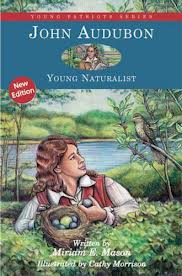
John Audubon: Young Naturalist by Miriam E Mason and Cathy Morrison (c. 2006) presents a great overview of Audubon's childhood and youth.  I would recommend this book for 2nd - 4th grade readers. Although, we did find the illustrations a little odd.

Saturday, February 16, 2013

Farmer Boy


I’ve been reading Farmer Boy to the kids.  It begins in winter, which is fitting to begin reading it together in January.  Personally, Farmer Boy and Little House in the Big Woods are my favorite of all of Laura Ingalls Wilder’s Little House on the Prairie series.  I’ll explain why shortly.

While I’ve been reading Farmer Boy aloud, I’ve gone back and read By the Shores of Silver Lake, The Long Winter, Little Town on the Prairie, These Happy Golden Years, and The First Four Years to myself.  Folks, there’s a whole different perspective re-reading these stories as an adult!

The kids play this little game that they “invented” as we read books and stories: midway through the story or at the story’s end, they say, “I wanna be _________.”  And now, they quickly “call” whom they want to be before the other one “calls it.”  Funny isn’t it. Isn’t that how we all read books and stories, though?!  We read self-reflectively.  Occasionally, I get a “Momma, I do NOT want to be __________.”  So subversively, we’re interpreting positive and negative character traits through the characters we read.

So where am I going with this?  Well, Farmer Boy has always been my favorite because, instinctively, I would have much rather lived with the Wilder family on a New England farm than with the Ingalls family out in the middle of nowhere Kansas or nowhere South Dakota.  And after getting through The Long Winter (which could also be called the long, cold story), I’m wondering if I would rather be a lady’s maid on Downton Abbey, working those long, grueling hours, than be Laura Ingalls Wilder.  At least the lady’s maid could live in the warm “big house” without starving!


Don’t misunderstand me, though.  As a little girl, I absolutely LOVED reading all of Laura Ingalls Wilder’s tales!  And now as an adult, I've delighted in re-reading them.  There is a new fascination and appreciation gained in re-reading her stories.  One thing that stands out is the remarkable way she remembers and retells a story for children.  And in retelling her husband’s story in Farmer Boy (and his “side” in The Long Winter, etc.), it became clear to me that we don’t share the oral stories of our own lives with our children enough.  I also questioned if we’re creating story-telling moments in our daily lives.  Let’s face it, we can’t create a book about: “Well, all I did today was play Pac-Man on Atari, and then when I was bored of that, I watched hours of MTV, and then I went to soccer practice, came home, ate, and went to bed.”  For as difficult and mundane as the Wilder’s lives were, they have incredible stories to share!

So my challenge to you, readers, is this: if you’re a young reader, pick up one of Laura Ingalls Wilder’s books (there are 9-11 to choose from) and read it.  If you’re an adult, pick up one of Wilder’s books and re-read it.  And please come back to http://readmeastorynow.blogspot.com/ and share with our readers about your experience reading these tales of life from a bygone era.

Sunday, February 10, 2013

The Great Backyard Bird Count!

I first heard about the bird count from Happy Homemaker UK in her post last year about the "Big Garden Birdwatch."  I so desired to do our own bird count but couldn't find information on it anywhere . . . that is . . . until . . . this year!  Those of us around here at ReadMeAStory cannot possibly wait until Friday, February 15, when the Great Backyard Bird Count begins.

So what's it all about?  
From Feb. 15 through Feb. 18, folks across the nation will be spending at least 15 min. (or longer) a day watching the birds in their own backyard.  We'll count, record, and report all the birds we see.

What's the point? Why?
(as copied exactly from http://www.birdsource.org/gbbc/whycount.html):

Scientists and bird enthusiasts can learn a lot by knowing where the birds are. Bird populations are dynamic; they are constantly in flux. No single scientist or team of scientists could hope to document and understand the complex distribution and movements of so many species in such a short time.
The longer these data are collected, the more meaningful they become in helping scientists investigate far-reaching questions, like these:

• How will the weather influence bird populations?

• Where are winter finches and other “irruptive” species that appear in large numbers during some years but not others?

• How will the timing of birds’ migrations compare with past years?

• How are bird diseases, such as West Nile virus, affecting birds in different regions?

• What kinds of differences in bird diversity are apparent in cities versus suburban, rural, and natural areas?
The Great Backyard Bird Count is led by the Cornell Lab of Ornithology and National Audubon Society, with Canadian partner Bird Studies Canada and sponsorship from Wild Birds Unlimited.

In other words:
We're participating in a science experiment by helping provide research and statistics for the National Audubon Society's various bird studies, including bird migratory patterns.  So by participating only 15 min. a day, we're contributing to legitimate research!

Some of our favorite birdwatching books around here at ReadMeAStory include:


COUNTING is for the Birds by Frank Mazzola, Jr. (c. 1997) covers several developmental skills all at once.  While teaching your child to count to twenty, Mazzola introduces rhyme, bird facts, number recognition, bird species identification, all while weaving together a hidden plotline.


The kids' very favorite bird identification guide is The Pocket Naturalist Guide: South Carolina Birds: An Introduction to Familiar Species (State Nature Guides) [Pamphlet] by James Kavanagh (c. 2002).  Read more about this resource on my post about The Pocket Naturalist Guides


Our Yard is Full of Birds (c.1992) by the mother daughter team Anne & Lizzy Rockwell tells a boy's story of bird watching while identifying various species of birds.  Lizzy Rockwell's watercolor and pencil illustrations beautifully capture each bird's unique traits.

Saturday, February 2, 2013

February


Find "February" in A Child's Calendar, a collection of twelve of John Updike's poems that describes a child's journey through the seasons from January through December  (c. 1965).  Caldecott award winning artist Trina Schart Hyman illustrated the collection (c. 1999).

Monday, January 14, 2013

January


Find "January" in A Child's Calendar, a collection of twelve of John Updike's poems that describes a child's journey through the seasons from January through December  (c. 1965).  Caldecott award winning artist Trina Schart Hyman illustrated the collection (c. 1999).

Wednesday, December 19, 2012

Charles Dickens rescues Christmas with A Christmas Carol

During this week in 1843, Charles Dickens published A Christmas Carol in Prose: Being A Ghost Story of Christmas. Let me tell you a little known fact (although, quite well known to the literary world): we can thank Charles Dickens for saving our modern day celebration of Christmas!  Yep, Charles Dickens, the Victorian author, saved the celebration of Christmas when he published the instantly popular A Christmas Carol!


An authorial context: Dickens authentically represented a broad range of British population through his true depictions of life among various socio-economic backgrounds. Essentially, through his writing, he became a voice for the abused, ill-treated lower classes and raised awareness to better working conditions, living conditions, child labor reform, etc.  His vivid characters unforgettably imprint themselves to memory and everyday conversation, point-in-case: "Scrooge" has become a vocabulary word, a noun meaning miser or the like.  Consequently, Dickens' characters and authenticity endeared him to the vast reading public and made him equivalent to a modern day rock-star.  Seriously, he is recognized as one of the very first "celebrities" in history.

Christmas needed rescuing? Due to Oliver Cromwell's influence in the mid 1600s (a.k.a. the English Civil War), the British slowly neglected the Medieval traditions of caroling and feasting during the Christmas season until Prince Albert (Queen Victoria's husband, mid 1800s) gallantly reintroduced the Germanic traditions of caroling and cards and, most significantly, introduced the Christmas tree.

What was Dickens's part in this rescue?  Well, even though Prince Albert did his part to reintroduce English and Germanic Christmas traditions, he worked against the routines and national mindset established by the Industrial Revolution. You see, British businessmen, manufacturing employers, and mill owners had grown quite stingy -- think Scrooge -- by treating Christmas as just another 10-12 hour workday.  So the impoverished, working class toiled through Christmas Day without any additional compensation.

So, in late 1843, Dickens published A Christmas Carol, creating some of the most memorable characters in literature.  And in contrasting a stingy Scrooge with a poor suffering Tiny Tim Crachit and jolly Christmas celebrators Nephew Fred and Fizziwig against the backdrop of ghosts past-present-and-future, Dickens lured the public into a benevolent celebration of Christmas.  Consider: wouldn't you rather be identified with Fizziwig than with Scrooge?!!

The rest is, as they say, history: Christmas once again became a season of giving and charitable behavior on both sides of the Atlantic.  Dickens, through his story, helped reestablish our present day mind-set of Christmas as a season of renewal in goodwill, "peace on earth to all men," and familial bonds.

"And so, as Tiny Tim observed, God bless Us, Every One!" (Dickens 158).

The featured edition: In discovering P. J. Lynch's illustrated version of A Christmas Carol (c. 2006), I have found the quintessential copy of Dickens' enduring tale.  What amazes me is how well Lynch captures Dickens' characters!  This is an illustrator who not only knows his author's works, but must have researched those illustrators who worked so closely with Dickens -- think ocd authorial input on each illustration.  I'd like to think that if Dickens were alive today, he wouldn't be more pleased with Lynch's representation of his classic Christmas tale. Take time this holiday season to read Dickens A Christmas Carol, and if you get the opportunity, read P. J. Lynch's beautifully illustrated edition.  I guarantee you, if the story doesn't haunt you, the illustrations will.


Disclaimer: it's very difficult for me to give credit where credit is due because I'm working from memory on this post.  I'm writing from decades of reading and admiring Charles Dickens and his many works.  I'm also writing from memory of various college lectures, in particular from a Dickens Seminar course.

Sunday, December 9, 2012

The MUST-read Christmas Book List

Here's our family's top 32 recommendations for the MUST-read Christmas Book List.
Click on the link to check out more book images and discover a brief synopsis of each story.  If the title doesn't have a link yet, check back, for I'll have a posting by the end of December.


The Classics:


The Night Before Christmas by Clement C. Moore
The Very First Christmas:

The Twelve Days of Christmas:

The Nutcracker:

The stories that will warm your heart:

Friday, November 30, 2012

December


Find "September" in A Child's Calendar, a collection of twelve of John Updike's poems that describes a child's journey through the seasons from January through December  (c. 1965).  Caldecott award winning artist Trina Schart Hyman illustrated the collection (c. 1999).

Wednesday, November 28, 2012

Mrs. Piggle-Wiggle


So you loved P. L Travers and/or Disney's Mary Poppins (yes, they're different), and your kids are begging for more.  Enter: Betty MacDonald's Mrs. Piggle-Wiggle (text c. 1947, renewed 1975).  And critically acclaimed artists Hilary Knight's pictures (illustrations c. 1957) and Alexandra Boiger's illustrations are a wonderful addition to MacDonald's charming text.
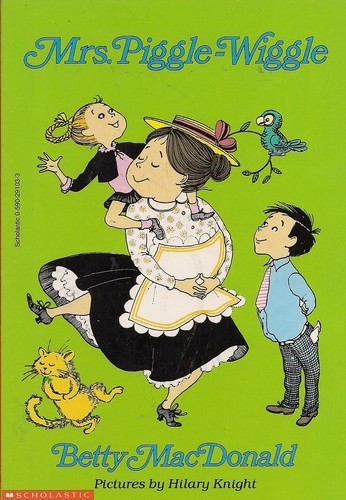
Betty MacDonald spun her stories first to her daughters' delight and then for the whole world to enjoy.  As our publisher (Scholastic) accounts: Everyone loves Mrs. Piggle-Wiggle.  She lives in an upside-down house and smells like cookies.  She was even married to a pirate once.  Most of all, she knows everything about children.  She can cure them of any ailment.  Patsy hates baths.  Robert never puts anything away.  Allen eats v-e-r-y slowly.  Mrs. Piggle-Wiggle has a treatment for all of them.
Ages 6 to 10

And when you discover that you have reached the end of the book and the kids are still begging for more, don't fret, there's always: Mrs. Piggle-Wiggle's Magic, Hello, Mrs. Piggle-Wiggle, and Mrs. Piggle-Wiggle's Farm (illustrated by none other than Maurice Sendak)

This post is lovingly dedicated to all four of the Lewis children.  Have a great week, friends!


Tuesday, October 2, 2012

October


Find "October" in A Child's Calendar, a collection of twelve of John Updike's poems that describes a child's journey through the seasons from January through December  (c. 1965).  Caldecott award winning artist Trina Schart Hyman illustrated the collection (c. 1999).