Showing posts with label America. Show all posts

Saturday, February 23, 2013

Boy Naturalist

Okay folks, I've learned some new things reading the kids' books.  For one, did you know that John James Audubon disproved Aristotle's (and then current) scientific theory that birds don't fly underwater during winter . . . they migrate south.  Now it seems downright silly to even imagine that people used to believe this as truth.  But what is absolutely fascinating to my kids and me is that Audubon disproved the theory while he was a teen.  Not only that, he recognized and copied bird calls and songs when he wasn't even in the "double-digits."

The kids were amazed by other stories of Audubon's life.  In fact, we couldn't get enough of him.  We kept searching for more books and more stories.

If you'd like to read some stories of wanderlust and adventure, you must check out both the childhood and adult stories of John James Audubon.  And then after you've heard the tales of the talented artist / naturalist, check out the books with his very own, intricate bird illustrations.  This has been a delightful exploration week at ReadMeAStory!  I hope your family enjoys the biographies and illustrations as much as we have!

Here are some of our favorites:

Begin with The Boy Who Drew Birds: a story of John James Audubon by Jacqueline Davies and illustrated by Melissa Sweet (c. 2004), which Sweet beautifully illustrates herself, sometimes copying Audubon's field book, note-taking, sketching perspective.

Audubon: Painter of Birds in the Wild Frontier by Jennifer Armstrong and Jos. A Smith (c. 2003) presents three of our favorite WOW stories in Audubon's adulthood.  This book presents Audubon as more of a Daniel Boone frontiersman and explorer than the other books did.


You may also want to check out:
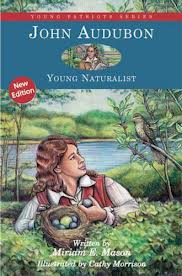
John Audubon: Young Naturalist by Miriam E Mason and Cathy Morrison (c. 2006) presents a great overview of Audubon's childhood and youth.  I would recommend this book for 2nd - 4th grade readers. Although, we did find the illustrations a little odd.

Saturday, February 16, 2013

Farmer Boy


I’ve been reading Farmer Boy to the kids.  It begins in winter, which is fitting to begin reading it together in January.  Personally, Farmer Boy and Little House in the Big Woods are my favorite of all of Laura Ingalls Wilder’s Little House on the Prairie series.  I’ll explain why shortly.

While I’ve been reading Farmer Boy aloud, I’ve gone back and read By the Shores of Silver Lake, The Long Winter, Little Town on the Prairie, These Happy Golden Years, and The First Four Years to myself.  Folks, there’s a whole different perspective re-reading these stories as an adult!

The kids play this little game that they “invented” as we read books and stories: midway through the story or at the story’s end, they say, “I wanna be _________.”  And now, they quickly “call” whom they want to be before the other one “calls it.”  Funny isn’t it. Isn’t that how we all read books and stories, though?!  We read self-reflectively.  Occasionally, I get a “Momma, I do NOT want to be __________.”  So subversively, we’re interpreting positive and negative character traits through the characters we read.

So where am I going with this?  Well, Farmer Boy has always been my favorite because, instinctively, I would have much rather lived with the Wilder family on a New England farm than with the Ingalls family out in the middle of nowhere Kansas or nowhere South Dakota.  And after getting through The Long Winter (which could also be called the long, cold story), I’m wondering if I would rather be a lady’s maid on Downton Abbey, working those long, grueling hours, than be Laura Ingalls Wilder.  At least the lady’s maid could live in the warm “big house” without starving!


Don’t misunderstand me, though.  As a little girl, I absolutely LOVED reading all of Laura Ingalls Wilder’s tales!  And now as an adult, I've delighted in re-reading them.  There is a new fascination and appreciation gained in re-reading her stories.  One thing that stands out is the remarkable way she remembers and retells a story for children.  And in retelling her husband’s story in Farmer Boy (and his “side” in The Long Winter, etc.), it became clear to me that we don’t share the oral stories of our own lives with our children enough.  I also questioned if we’re creating story-telling moments in our daily lives.  Let’s face it, we can’t create a book about: “Well, all I did today was play Pac-Man on Atari, and then when I was bored of that, I watched hours of MTV, and then I went to soccer practice, came home, ate, and went to bed.”  For as difficult and mundane as the Wilder’s lives were, they have incredible stories to share!

So my challenge to you, readers, is this: if you’re a young reader, pick up one of Laura Ingalls Wilder’s books (there are 9-11 to choose from) and read it.  If you’re an adult, pick up one of Wilder’s books and re-read it.  And please come back to http://readmeastorynow.blogspot.com/ and share with our readers about your experience reading these tales of life from a bygone era.

Sunday, February 10, 2013

The Great Backyard Bird Count!

I first heard about the bird count from Happy Homemaker UK in her post last year about the "Big Garden Birdwatch."  I so desired to do our own bird count but couldn't find information on it anywhere . . . that is . . . until . . . this year!  Those of us around here at ReadMeAStory cannot possibly wait until Friday, February 15, when the Great Backyard Bird Count begins.

So what's it all about?  
From Feb. 15 through Feb. 18, folks across the nation will be spending at least 15 min. (or longer) a day watching the birds in their own backyard.  We'll count, record, and report all the birds we see.

What's the point? Why?
(as copied exactly from http://www.birdsource.org/gbbc/whycount.html):

Scientists and bird enthusiasts can learn a lot by knowing where the birds are. Bird populations are dynamic; they are constantly in flux. No single scientist or team of scientists could hope to document and understand the complex distribution and movements of so many species in such a short time.
The longer these data are collected, the more meaningful they become in helping scientists investigate far-reaching questions, like these:

• How will the weather influence bird populations?

• Where are winter finches and other “irruptive” species that appear in large numbers during some years but not others?

• How will the timing of birds’ migrations compare with past years?

• How are bird diseases, such as West Nile virus, affecting birds in different regions?

• What kinds of differences in bird diversity are apparent in cities versus suburban, rural, and natural areas?
The Great Backyard Bird Count is led by the Cornell Lab of Ornithology and National Audubon Society, with Canadian partner Bird Studies Canada and sponsorship from Wild Birds Unlimited.

In other words:
We're participating in a science experiment by helping provide research and statistics for the National Audubon Society's various bird studies, including bird migratory patterns.  So by participating only 15 min. a day, we're contributing to legitimate research!

Some of our favorite birdwatching books around here at ReadMeAStory include:


COUNTING is for the Birds by Frank Mazzola, Jr. (c. 1997) covers several developmental skills all at once.  While teaching your child to count to twenty, Mazzola introduces rhyme, bird facts, number recognition, bird species identification, all while weaving together a hidden plotline.


The kids' very favorite bird identification guide is The Pocket Naturalist Guide: South Carolina Birds: An Introduction to Familiar Species (State Nature Guides) [Pamphlet] by James Kavanagh (c. 2002).  Read more about this resource on my post about The Pocket Naturalist Guides


Our Yard is Full of Birds (c.1992) by the mother daughter team Anne & Lizzy Rockwell tells a boy's story of bird watching while identifying various species of birds.  Lizzy Rockwell's watercolor and pencil illustrations beautifully capture each bird's unique traits.

Sunday, November 25, 2012

The Quiet Place


The eldest checked out a new book, which was entitled The Quiet Place (c. 2012) by Sarah Stewart with pictures by David Small.  What ended up surprising me most was discovering I couldn't get through it without choking up!
              "Momma, why are you crying?"
              "Because . . . this story . . . is just . . . so . . . moving!"


What are the publishers saying about it?
When Isabel and her family move to the United States, Isabel misses all the things she left behind in Mexico, especially her Aunt Lupita and the sound of people speaking Spanish.  But she also experiences some wonderful new things -- her first snowstorm and a teacher who always greets her with a big smile.  Even better, Papa and her brother, Chavo, help her turn a large box into her own quiet place, where she keeps her books and toys and writes letters to Aunt Lupita.  As she decorates and adds more and more boxes to her quiet place, it is here that Isabel feels most at home in her new country while she learns to adapt to the changes in her life.

Set in the 1950s and told through Isabel's letters to her aunt, this story of immigration and assimilation will win the hearts of readers.  The husband-and-wife team of Sarah Stewart and Caldecott Medalist David Small has once again created an utterly charming and unforgettable young heroine.

And once we finished the book, the child said:
               "That was a really cool story, Mom!"

Wednesday, November 21, 2012

November


Find "November" in A Child's Calendar, a collection of twelve of John Updike's poems that describes a child's journey through the seasons from January through December  (c. 1965).  Caldecott award winning artist Trina Schart Hyman illustrated the collection (c. 1999).

Monday, November 19, 2012

This First Thanksgiving Day

Dear Readers,

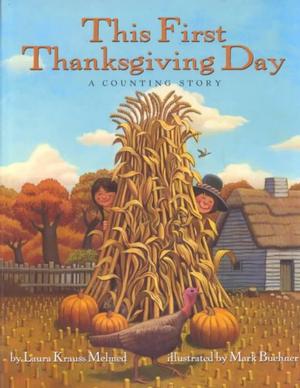
Two years ago, I recommended to my young friends a story entitled This First Thanksgiving Day by Laura Krauss Melmed and Mark Buehner (c. 2001).  Well, I stand corrected!  My elementary friends have quite enjoyed this Thanksgiving story too!

Revisit my previous post here.  Then consider letting the older readers read it to their younger siblings.  And while the younger siblings look for the hidden turkey on each two-page spread, have the older siblings look for that quirky dinosaur on various spreads (we're still not sure just how many).  While the younger siblings count the people on each spread, have the older siblings practice their addition by finding and then adding the various animals (squirrels, rabbits, fish, birds, geese, chickens, etc.) on each spread.  Either way, enjoy the fun activities while celebrating Thanksgiving!

Parents, this would be a great book to check out before that long car trip or while you're trying to get dinner on the table but the Macy's Day Parade ended hours ago.

Saturday, November 17, 2012

Over the River and Through the Wood


Y'all know how Brinton Turkle's illustrated version of Over the River and Through the Wood (c. 1974) has been my all-time favorite interpretation of Lydia Maria Child's famous poem turned song.

Well, now there's a fierce competitor!  Take a look at Matt Tavares' illustrated version entitled: Over the River and Through the Wood: The New England Boy's Song About Thanksgiving Day (c. 2011).

One word: BEAUTIFUL!  Tavares cleverly weaves a story using the warm and humorous notes of a good storyteller . . . all through the media of pencil and paint brush.  In fact, I would love to frame the opening title-page spread.

So just in time for Thanksgiving . . . check it out!


Also, (or if you can't make it to the library in time) discover the illustration process through the actions of artist Matt Tavares':


Monday, August 6, 2012

August


Find "August" in A Child's Calendar, a collection of twelve of John Updike's poems that describes a child's journey through the seasons from January through December  (c. 1965).  Caldecott award winning artist Trina Schart Hyman illustrated the collection (c. 1999).


Thursday, June 21, 2012

Iron Horses

Dedicated to all my train-loving readers: Have you ever wandered how the transcontinental railroad was built?  "Transcontinental Railroad?" you ask.  It was the joining of the American west's Central Pacific Railroad to the east's Union Pacific Railroad so that citizens could travel from one coast to the next in a matter of days rather than months.

Discover this train race afresh with Verla Kay's simple rhyming text and Michael McCurdy's signature illustrations in Iron Horses (c. 1999).

Monday, January 16, 2012

Martin's Big Words

Doreen Rappaport weaves together her words and Dr. King's words in the Caldecott honor book, illustrated by Bryan Collier, Martin's Big Words: The Life of Dr. Martin Luther King, Jr. (c. 2001).
 
Martin said 'love'
when others said 'hate.'

'Hate cannot drive out hate.
Only love can do that.'

Saturday, November 5, 2011

Home


I brought Thomas Locker's HOME: A Journey Through America (c. 1998) home from the library, laid it out on the coffee table, and waited.  My youngest picked it up, poured over it, and came running to me: "Mommy, this pictures look beautifully!"


That afternoon the eldest came home from school, poured over the new-found book, and said, "Momma, you have got to look at these pictures!  These are my favorites."


I think old and young alike are amazed that Thomas Locker shares his magnificent oil on canvas landscape paintings not only in art galleries or museums but in childrens' books for all to enjoy.  Seriously, introduce your child to the fine art of Thomas Locker.  You may be astonished at the art appreciation that issues out of his/her mouth.

Wednesday, October 19, 2011

Tuttle's Red Barn


Tuttle's Red Barn: The Story of America's Oldest Family Farm 
by Richard Michelson
Illustrated by Mary Azarian
copyright 2007

We stumbled upon this dear book, and even the kids sat through the whole long family tree of a story.  I'd sit here and chatter on about it for hours, but really, the publisher G.P. Putnam's Sons did such a fabulous job with its jacket leaf write-up that I won't reinvent the wheel in saying anymore:

The story of Tuttle's Red Barn is the story of America.  John Tuttle arrived in Dover, New Hampshire, in 1632 with only his father's ax an the two pewter candleholders his mother had given him after they'd hugged good-bye.  But from that humble beginning he built the farm that, today, still stands on the same land.

Twelve generations have tilled this New England soil, taking part in many great milestones of American history along the way.  The Tuttle family fought in the Revolutionary War, protected slaves on the Underground Railroad, and helped pave the way for the Industrial Revolution.  A Tuttle was even there to offer maple syrup to Abraham Lincoln when he visited Dover!

A fascinating look at America as seen through the eyes of one family, Tuttle's Red Barn is a must-read for anyone who appreciates the story of our country.  Caldecott medalist Mary Azarian's vibrant woodcut illustrations accompany Richard Michelson's informative and remarkable account of one family that has stayed connected through the centuries by a love of family, and one big red barn.

And if you'd like to see Tuttle's present day red barn and surrounding landscapes, here are some links:
http://www.flickr.com/photos/catchesthelight/3488876560/
http://richardmichelson.com/tuttle/book-release.html

Here's a fascinating interview with the illustrator, Mary Azarian:
http://richtexts.blogspot.com/2011/09/green-mountain-magic.html

Monday, October 10, 2011

Ox-Cart Man


Do you remember this book?  I think I first discovered it via Reading Rainbow as LeVar Burton read it to his audience.  Ox-Cart Man (c. 1979) by Donald Hall with Caldecott award winning illustrations by our beloved Barbara Cooney recalls the days of a 19th century New England family.  Take a journey back in time from the moment you open the first page:

                                           In October he backed his ox into his cart
                                           and he and his family filled it up
                                          with everything they made or grew all year long
                                          that was left over.


A beautiful depiction of early settler life throughout the seasons, Ox-Cart Man takes the ten day travel to town to trade his goods for the necessities for surviving the next year on his family farm.

Monday, July 4, 2011

The Star-Spangled Banner


When I was a little girl, my favorite holiday was the 4th of July.  Looking back, I'm trying to remember if it beat out Christmas, or if it was a neck and neck holiday tie.  Probably both.  I loved 4th of July picnics, eating juicy, beefy hamburgers slathered in ketchup, mustard, and pickles.  I loved spending time with family, singing patriotic songs, waving American flags, and listening to bands play the national anthem.  But the highlight came after sundown, when the sky lit up with the brilliant sparkles and various colors of fireworks.  I sat mesmerized by the glorious sight, trying to decide which showstopper was my favorite . . . each display exceeding the last . . . and all of them magically synchronized to a patriotic soundtrack.


Take all of this, and imagine the inspiration of our national anthem birthed out of heavy shelling and rocketing bombs.  It happened during the War of 1812, when the British bombarded Baltimore's Fort McHenry for a twenty-five hour stint.  Frances Scott Key penned these resonating words when he spotted our American flag gloriously waving out of the smog and battle's fray.  From the unfurling of that "Star-Spangled Banner" raised over Fort McHenry, we Americans gained a national anthem.  Check out Peter Spier's superb depiction of history in his illustrated book The Star-Spangled Banner (c. 1973).  Spier illustriously represents each stanza of the anthem and provides a concise history in the appendix.

You may also enjoy Peter Spier's We the People: The Constitution of the United States of America (c. 1987). And have a happy 4th of July, dear readers!

Sunday, July 3, 2011

America the Beautiful


Wendell Minor took my breath away with America the Beautiful (c. 2003).  WOW!  There have been very few books that have left me speechless after I've read them.  This is one of them.  At the same time that it left me speechless, it left my heart swelling with pride to be an American.  Minor's watercolor paintings are breathtaking.  From the Kennedy Space Center in Cape Canaveral, Florida to Heceta Head, Oregon and Yosemite National Park in California to Falmouth Massacusetts, each spread represents a specific region or state in our country, perfectly paired with each verse in this unforgettable anthem.  Minor also provides the fascinating story behind Katharine Lee Bates' poem turned song, complete with concise biographies.  Minor's book reflects our countries majestic landscape in his masterpieces as well as carefully researched text in the appendices.  A jewel to share with your children, don't neglect to check out this brilliant book.