So are you ready for some more of P. D. Eastman's I CAN READ book titles?
In Snow (c. 1962), P. D. Eastman teamed up with Roy McKie in writing and illustrating a perfect beginner I CAN READ book for the winter season. Thankfully, this is one of those titles that has experienced copyright renewal, so I recently found our copy at Marshalls for just a fraction of the price.
And as you know, our kids much prefer P.D. Eastman to Dr. Seuss, and I still haven't figured out why. I don't know if it's the illustrations or if they can better picture themselves in the story or if the plot is more predictable for an early reader, but Eastman's books are the ones they keep returning to again and again.
Let me share with you a few of our favorite illustrations from Snow:
One parent's (and her kids') guide to navigating the library and bookstore. My recommendations in children's book classics . . . literature for little ones, then and now.
Showing posts with label Snow. Show all posts
Saturday, February 2, 2013
Snow
Labels:
Ages 0-8,
Family,
Friends,
Humorous,
I Can Read,
Rhyme,
Snow,
Winter,
zz: Eastman-P.D.,
zz: McKie-Roy
Tuesday, January 15, 2013
The Mitten
Wow! I can't believe that I'm just now encouraging you to read The Mitten. This is another one in that building list of "must reads"! Which edition should you check out? Hmmmmm, well, I leave that for you to decide. Around here we have two favorites:
The Mitten, A Ukrainian Folktale adapted and illustrated by Jan Brett (c. 1989), is arguably Brett's best work. There's something for everyone is this edition. The younger set will enjoy the simplicity and humor of the tale while the older set will pick up on the additional narratives "told" in Brett's right and left sidebar illustrations.
Note: The youngest's preK class enjoyed it all last week -- first through reading and then through a hands-on coloring / sequencing activity, which you can download and print too. Have your children color, cut, then reinact the story by stuffing their own mitten full of forest animals from these pages on Jan Brett's website: http://janbrett.com/put_the_animals_in_the_mitten.htm
You also can't go wrong with The Mitten An Old Ukrainian Folktale retold by Alvin Tresselt and illustrated by Yaroslava (c. 1964). Yaroslava's simple yet vibrant illustrations feel "old world" and lend a sort of different sort of credibility to the tale.
Either way, readers, I'd love to hear your preference! Which story do your kids like best?
Note: The youngest's preK class enjoyed it all last week -- first through reading and then through a hands-on coloring / sequencing activity, which you can download and print too. Have your children color, cut, then reinact the story by stuffing their own mitten full of forest animals from these pages on Jan Brett's website: http://janbrett.com/put_the_animals_in_the_mitten.htm
You also can't go wrong with The Mitten An Old Ukrainian Folktale retold by Alvin Tresselt and illustrated by Yaroslava (c. 1964). Yaroslava's simple yet vibrant illustrations feel "old world" and lend a sort of different sort of credibility to the tale.
Either way, readers, I'd love to hear your preference! Which story do your kids like best?
Wednesday, December 19, 2012
Charles Dickens rescues Christmas with A Christmas Carol
During this week in 1843, Charles Dickens published A Christmas Carol in Prose: Being A Ghost Story of Christmas. Let me tell you a little known fact (although, quite well known to the literary world): we can thank Charles Dickens for saving our modern day celebration of Christmas! Yep, Charles Dickens, the Victorian author, saved the celebration of Christmas when he published the instantly popular A Christmas Carol!
An authorial context: Dickens authentically represented a broad range of British population through his true depictions of life among various socio-economic backgrounds. Essentially, through his writing, he became a voice for the abused, ill-treated lower classes and raised awareness to better working conditions, living conditions, child labor reform, etc. His vivid characters unforgettably imprint themselves to memory and everyday conversation, point-in-case: "Scrooge" has become a vocabulary word, a noun meaning miser or the like. Consequently, Dickens' characters and authenticity endeared him to the vast reading public and made him equivalent to a modern day rock-star. Seriously, he is recognized as one of the very first "celebrities" in history.
Christmas needed rescuing? Due to Oliver Cromwell's influence in the mid 1600s (a.k.a. the English Civil War), the British slowly neglected the Medieval traditions of caroling and feasting during the Christmas season until Prince Albert (Queen Victoria's husband, mid 1800s) gallantly reintroduced the Germanic traditions of caroling and cards and, most significantly, introduced the Christmas tree.
What was Dickens's part in this rescue? Well, even though Prince Albert did his part to reintroduce English and Germanic Christmas traditions, he worked against the routines and national mindset established by the Industrial Revolution. You see, British businessmen, manufacturing employers, and mill owners had grown quite stingy -- think Scrooge -- by treating Christmas as just another 10-12 hour workday. So the impoverished, working class toiled through Christmas Day without any additional compensation.
So, in late 1843, Dickens published A Christmas Carol, creating some of the most memorable characters in literature. And in contrasting a stingy Scrooge with a poor suffering Tiny Tim Crachit and jolly Christmas celebrators Nephew Fred and Fizziwig against the backdrop of ghosts past-present-and-future, Dickens lured the public into a benevolent celebration of Christmas. Consider: wouldn't you rather be identified with Fizziwig than with Scrooge?!!
The rest is, as they say, history: Christmas once again became a season of giving and charitable behavior on both sides of the Atlantic. Dickens, through his story, helped reestablish our present day mind-set of Christmas as a season of renewal in goodwill, "peace on earth to all men," and familial bonds.
The featured edition: In discovering P. J. Lynch's illustrated version of A Christmas Carol (c. 2006), I have found the quintessential copy of Dickens' enduring tale. What amazes me is how well Lynch captures Dickens' characters! This is an illustrator who not only knows his author's works, but must have researched those illustrators who worked so closely with Dickens -- think ocd authorial input on each illustration. I'd like to think that if Dickens were alive today, he wouldn't be more pleased with Lynch's representation of his classic Christmas tale. Take time this holiday season to read Dickens A Christmas Carol, and if you get the opportunity, read P. J. Lynch's beautifully illustrated edition. I guarantee you, if the story doesn't haunt you, the illustrations will.
Disclaimer: it's very difficult for me to give credit where credit is due because I'm working from memory on this post. I'm writing from decades of reading and admiring Charles Dickens and his many works. I'm also writing from memory of various college lectures, in particular from a Dickens Seminar course.
An authorial context: Dickens authentically represented a broad range of British population through his true depictions of life among various socio-economic backgrounds. Essentially, through his writing, he became a voice for the abused, ill-treated lower classes and raised awareness to better working conditions, living conditions, child labor reform, etc. His vivid characters unforgettably imprint themselves to memory and everyday conversation, point-in-case: "Scrooge" has become a vocabulary word, a noun meaning miser or the like. Consequently, Dickens' characters and authenticity endeared him to the vast reading public and made him equivalent to a modern day rock-star. Seriously, he is recognized as one of the very first "celebrities" in history.
Christmas needed rescuing? Due to Oliver Cromwell's influence in the mid 1600s (a.k.a. the English Civil War), the British slowly neglected the Medieval traditions of caroling and feasting during the Christmas season until Prince Albert (Queen Victoria's husband, mid 1800s) gallantly reintroduced the Germanic traditions of caroling and cards and, most significantly, introduced the Christmas tree.
What was Dickens's part in this rescue? Well, even though Prince Albert did his part to reintroduce English and Germanic Christmas traditions, he worked against the routines and national mindset established by the Industrial Revolution. You see, British businessmen, manufacturing employers, and mill owners had grown quite stingy -- think Scrooge -- by treating Christmas as just another 10-12 hour workday. So the impoverished, working class toiled through Christmas Day without any additional compensation.
So, in late 1843, Dickens published A Christmas Carol, creating some of the most memorable characters in literature. And in contrasting a stingy Scrooge with a poor suffering Tiny Tim Crachit and jolly Christmas celebrators Nephew Fred and Fizziwig against the backdrop of ghosts past-present-and-future, Dickens lured the public into a benevolent celebration of Christmas. Consider: wouldn't you rather be identified with Fizziwig than with Scrooge?!!
The rest is, as they say, history: Christmas once again became a season of giving and charitable behavior on both sides of the Atlantic. Dickens, through his story, helped reestablish our present day mind-set of Christmas as a season of renewal in goodwill, "peace on earth to all men," and familial bonds.
"And so, as Tiny Tim observed, God bless Us, Every One!" (Dickens 158).
The featured edition: In discovering P. J. Lynch's illustrated version of A Christmas Carol (c. 2006), I have found the quintessential copy of Dickens' enduring tale. What amazes me is how well Lynch captures Dickens' characters! This is an illustrator who not only knows his author's works, but must have researched those illustrators who worked so closely with Dickens -- think ocd authorial input on each illustration. I'd like to think that if Dickens were alive today, he wouldn't be more pleased with Lynch's representation of his classic Christmas tale. Take time this holiday season to read Dickens A Christmas Carol, and if you get the opportunity, read P. J. Lynch's beautifully illustrated edition. I guarantee you, if the story doesn't haunt you, the illustrations will.
Disclaimer: it's very difficult for me to give credit where credit is due because I'm working from memory on this post. I'm writing from decades of reading and admiring Charles Dickens and his many works. I'm also writing from memory of various college lectures, in particular from a Dickens Seminar course.
Monday, December 17, 2012
Good King Wenceslas
Do you know what I love about this season? I love:
So during this season of "Peace on earth, goodwill to men," King Wenceslas stands out as a model. You're familiar with the traditional carol, but do you know its origin? Well, the story of Good King Wenceslas shows us the purpose and the motive behind such benevolent, seasonal giving. John Mason Neale, an English Anglican priest, wrote the words to the carol "Good King Wenceslas" in 1853, for the feast following Christmas Day called Saint Stephen. Tradition holds that Neale derived his inspiration from actual events influenced by the just-minded and kindhearted King Wenceslas, ruler of tenth century Bohemia or the present day Czech Republic. In fact, a statue of King Wenceslas, or now Saint Wenceslas, stands in Wenceslas Square in Prague. (For photos of that statue, look at http://wemsha.blogspot.com/2010/06/wenceslas-square-prague.html).
Check out this fascinating book Good King Wenceslas (c. 2005), which looks at the story behind the inspiration of the carol. Tim Ladwig's remarkable illustrations give us a modern peak into the past. And be sure to take longer than a passing glance at that last illustration.
- packing our Operation Christmas Child boxes
- selecting gifts in the Samaritan's Purse Gift Catalog with the kids
- hearing the Salvation Army bells ring,
- reading all the charity benefit concerts, dinners, raffles, etc. being held,
- hearing of opportunities to take dry goods or meals to shut-ins, and
- discovering different opportunities to donate time and/or funds to help the less fortunate.
So during this season of "Peace on earth, goodwill to men," King Wenceslas stands out as a model. You're familiar with the traditional carol, but do you know its origin? Well, the story of Good King Wenceslas shows us the purpose and the motive behind such benevolent, seasonal giving. John Mason Neale, an English Anglican priest, wrote the words to the carol "Good King Wenceslas" in 1853, for the feast following Christmas Day called Saint Stephen. Tradition holds that Neale derived his inspiration from actual events influenced by the just-minded and kindhearted King Wenceslas, ruler of tenth century Bohemia or the present day Czech Republic. In fact, a statue of King Wenceslas, or now Saint Wenceslas, stands in Wenceslas Square in Prague. (For photos of that statue, look at http://wemsha.blogspot.com/2010/06/wenceslas-square-prague.html).
Check out this fascinating book Good King Wenceslas (c. 2005), which looks at the story behind the inspiration of the carol. Tim Ladwig's remarkable illustrations give us a modern peak into the past. And be sure to take longer than a passing glance at that last illustration.
Wednesday, February 22, 2012
Coming On Home Soon
Oh, this book is just simply beautiful!
Beautiful to read,
beautiful to look at,
beautiful to experience.
It puts new meaning to the expression breathakingly beautiful.
Check out: Coming On Home Soon (c. 2004) by Jacqueline Woodson and illustrated by E. B. Lewis. Here's the Publisher's (G. P. Putnam's Sons) summary on the inside cover jacket:
Ada Ruth, Mama said. Do you know I love you more than anything in the world?
Yes, ma'am, I whispered. More than rain.
More than snow, Mama whispered back, the way we'd done a hundred times before.
Or maybe a hundred thousand.
It's wartime, and women have to go to work while the men are off fighting. Ada Ruth's mama has a job in Chicago, and she must leave Ada Ruth and Grandma behind.
Now Ada Ruth and Grandma are missing Mama and trying to keep each other strong. But some days, it feels like nothing can fill the emptiness in their hearts. Then a surprise comes to their door and gives them something to fuss over while they wait for the letter that will say Mama's coming home soon.
In this timeless story, Woodson's evocative text and Lewis's captivating artwork capture all that comes with missing and waiting -- the sadness, the everyday living, the small surprises, and most of all, the hope.
Tuesday, February 14, 2012
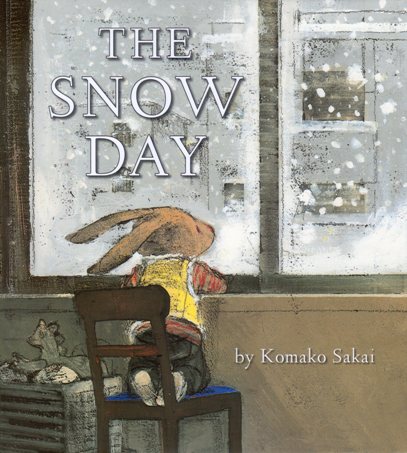
The Snow Day
Oh, I just love new finds! And around here, we've especially enjoyed this new find by Komako Sakai, The Snow Day (c. 2005). Son rabbit eagerly awaits his chance to play in the snow. He waits by the window all day.
My favorite part is the magical moonlight walk through the snow . . . brings back the memories! I'm telling you, the kids love this one . . . and . . . I've noticed the Mister asking if they'd like to hear The Snow Day . . . again! ;)
Saturday, February 4, 2012
February
Tuesday, January 31, 2012
It's Snowing!
We've found a new book, new because it was just published in 2011. It's Snowing by Gail Gibbons presents the science behind snowfall, drawing children in with her bright illustrations and maps.
What I especially like about Gail Gibbons easy to understand account is that she credits the National Weather Service and their meteorologists for her spot-on information. Yep, around here, we think VERY highly of the National Weather Service. We only get our weather information from http://weather.noaa.gov/ or http://weather.gov/ or NOAA Weather Radio (http://www.nws.noaa.gov/nwr/). Traveling? Then plan your trip by the National Weather Service's forecasts.
Looking for accuracy and expertise, then I encourage you to check out the National Weather Service as opposed to weather.com. Seriously, the statistics are the proof. And we may be a tad bit biased toward meteorologists; after all, Papa Terry did just retire from NWS.
Either way, Gail Gibbons gives an excellent, spot-on account explaining how snow forms, the different forms of winter precipitation, and how to prepare for winter weather. Check out It's Snowing! by Gail Gibbons, or purchase it from the recent Scholastic handouts. It's well worth the effort! For my part, I plan on purchasing our own copy.
Labels:
Ages 0-8,
Picture Book,
Science,
Snow,
Weather,
Winter,
zz: Gibbons-Gail
Monday, January 30, 2012
Ugggghh! It is in the mid-60s this week! I can count on one hand how many times we've cozied up to a fire in our fireplace this winter. The daffodils are peeping through. It's January, and I've actually had to pull up hand upon hand full of weeds. Don't get me wrong, I love warm weather and digging in the dirt! . . . just not in January. In January, I assume I get a month or so off from weeds.
So, needless to say, it's been tricky to blog because my heart wants to blog winter and snow books. But it's tough to find the motivation.
However, we've been checking out lots of snow books. My kids are begging to see snow, so right now, this is as good as it's going to get. So retreat back into your imagination these next few weeks, and we'll get our snow fix through the written word.
First, check out First Snow by Emily Arnold McCully (c. 1985). Here's a wordless book about a mouse family enjoying the first snow together. So much is said through these illustrations. Enjoy having your kids supply their own commentary. Books like these are WONDERFUL because they allow your child to flex his/her imagination to create his own story. So, check it out!
So, needless to say, it's been tricky to blog because my heart wants to blog winter and snow books. But it's tough to find the motivation.
However, we've been checking out lots of snow books. My kids are begging to see snow, so right now, this is as good as it's going to get. So retreat back into your imagination these next few weeks, and we'll get our snow fix through the written word.
First, check out First Snow by Emily Arnold McCully (c. 1985). Here's a wordless book about a mouse family enjoying the first snow together. So much is said through these illustrations. Enjoy having your kids supply their own commentary. Books like these are WONDERFUL because they allow your child to flex his/her imagination to create his own story. So, check it out!
Saturday, January 21, 2012
When Winter Comes
I've raved over Susan Gaber's illustrations here and here before. Check out another of her illustrated books (c. 2000) with words by Nancy Van Laan.
Kids are mesmerized by When Winter Comes! Nana reads it to her class each winter. And my child came home from kindergarten a few weeks ago, exclaiming that her teacher read "one of my favorite books to the whole class today!" Yep, I think that teacher's pretty brilliant (especially as her students were just returning from winter break) because you see this read has quite the calming effect (like the gentle cadences of Stopping by Woods on a Snowy Evening). Catch a glimpse of it in the rhyme and repetition:
Where oh where do the leaves all go
when winter comes and the cold winds blow?
(next page)
The leaves go tumble
tumbling down.
Snow is their blanket.
Their bed is the ground.
So check it out, and tell me, which part do you like best: the soothing rhythm of VanLaan's rhyme or Gaber's soft snowy acrylic paintings or just the complete cozy, snugly, fireside experience of reading it to your child?
Saturday, January 14, 2012
William Shakespeare
" . . . winter tames man, woman and beast."
William Shakespeare
is published in sharing the seasons: A BOOK OF POEMS selected by Lee Bennett Hopkins and illustrated by David Diaz (c. 2010).
Tuesday, January 10, 2012
Honey Bear's Snowy Adventure
Hmmmmmm, well, our edition is entitled Honey Bear's Snowy Adventure.
However, it looks like amazon.com and the library now release this story under the title Little Honey Bear and the Smiley Moon (c. 2006). Both editions are written by Gillian Lobel and illustrated by Tim Warnes.
So, either way, Honey Bear is such a FUN book to read aloud! I really enjoy "doing" the four different voices. Maybe it's that snack at the end or maybe it's because it's another moon story or maybe it's just because it's a tale about fear being resolved with the appearance of Mommy: whatever the reason, it's a simple adventure the kids keep coming back to hear again and again.
Labels:
Ages 0-8,
Animals,
Family,
Friends,
Moon,
Picture Book,
Snow,
Tea time,
Winter,
zz: Lobel-Gillian,
zz: Warnes-Tim
Friday, January 6, 2012
Owl at Home
![]() |
| title page |
You remember Arnold Lobel, right?! He's the creator of our dear friends Frog and Toad.
Well, you must, must, must check out this cozy and funny winter read, an I CAN READ book entitled Owl at Home by Arnold Lobel (c. 1975). Let me give you a glimpse of my favorite illustrations:
![]() |
| beginning the chapter entitled The Guest |
![]() |
| beginning the chapter entitled Tear-Water Tea |
Now, don't you just want to visit owl? You can! Owl at Home is especially perfect for your budding reader or for that young reader who wants an advancement. The kids just love Owl! Our house is filled with laughter whenever we read this together. To tell the truth, Owl is a bit daft, but his daftness evokes the frolicking laughs that children enjoy. I could go into a more thorough explanation of each of Lobel's five stories, but suffice it to say, Owl at Home is an experience you won't want to miss!
![]() |
| end cover |
Labels:
Ages 0-8,
Animals,
I Can Read,
Snow,
Tea time,
Winter,
Witty,
zz: Lobel-Arnold
Tuesday, December 6, 2011
The Year of the Perfect Christmas Tree
If you read no other book recommendation from my blog this year, be sure to check out The Year of the Perfect Christmas Tree (c. 1988), by Gloria Houston and illustrated by Barbara Cooney, to read to the kids! It's a timeless story that sings the spirit of Christmas.
Barbara Cooney is not only one of our family's favorite illustrators, she's America's beloved illustrator, illustrator of over one hundred childrens' books and recipient of two Cladecott Medals. So glance over the illustrations, and you'll find that they speak for themselves.
In addition, acclaimed author Gloria Houston retells this heartwarming Appalachian story as it was passed down from her grandmother and mother.
So what's this perfect tale about? Let's read what the publishers have to say: "The Armistice has been declared, but still there is no sign of Ruthie's father in their little Appalachian town. So, in accordance with the traditions of Pine Grove, it falls to Ruthie and her mother to bring home the perfect Christmas tree to donate to the town. Ruthie had accompanied her father to the rocky cliff where he marked a tree in the spring, so she and her mother set out to find it again, and haul it home. Their trip becomes the basis overnight of a new town legend; [meanwhile] Ruthie [is] chosen for the role of the heavenly angel in the the church Christmas play . . ."
However, while Ruthie's father is away at war, many of the income earning responsibilities cannot be accomplished by Ruthie or her mother. So they scrimp where they can, leaving the question of an angel's costume and a Christmas gift for Ruthie an unattainable wish. Find out what happens to all these dilemmas in the story's joy filled ending. Just be sure have a tissue ready to wipe those tears.
Wednesday, February 9, 2011
Katy and the Big Snow
If you haven't read Katy and the Big Snow (c. 1943), drop what you're doing, run out to your local library, and check this book out before the kids come home from school! They'll be turning cartwheels! Mine absolutely loved it. We've read it several times, several days in a row, since the time we checked ours out. I guess it goes without saying, both illustrations and story line prove fascinating. I guarantee any of your young budding artists or map lovers will pour over it's pages. Virginia Lee Burton's story opens:
Katy was a beautiful red crawler tractor.
She was very big and very strong
and she could do a lot of things.
Aren't you just itching to see how it continues?! Discover how heroic Katy saves the day, and bask in that lovely worded very last line by re-reading it several times over.
Monday, January 24, 2011
The Biggest, Best Snowman
The kids love The Biggest, Best Snowman written by Margery Cuyler and illustrated by Will Hillenbrand. What can I say of this fun story that begs to be read aloud . . . it is a HOOT!Kids really identify with the character Little Nell because the "BIG" people in her life refuse to let her perform certain tasks due to her small stature. Little Nell sets out to the forest to prove that she can perform the large task of building a ginormous snowman. I won't tell you the ending, but I will tell you that the kids really bask in the gratification Cuyler provides. And this story rings timely as my own baby is increasingly asserting her independence and continuing to prove her capability.
Tuesday, January 18, 2011
Owl Moon
If you haven't read Owl Moon yet, then you're in for a real treat! I just finished reading it for the first time this year. The kids were clinging to me with anticipation for the next line. They were silently mesmerized, even though they've heard it before. Once we reached "the end" the children begged me to go"owling." Then they started scheming when and where we could make this "owling" trip actually happen.
In Owl Moon (c. 1987), by Jane Yolen and illustrated by John Schoenherr, Yolen writes about a father taking his little child into the late winter night to hunt for a Great Horned Owl. A full moon lights their path through the great wood, casting long dark shadows in their tracks.
Schoenherr's inspiration for his intricate illustrations derive from his own owling expeditions and landmarks on his family farm. Take note: Owl Moon won the Caldecott Medal in 1988 due to Schoenherr's hauntingly beautiful illustrations.
Yolen is known for her poetic language, and Owl Moon is no exception. I especially like that last page of lines about "hope"! If you'd like to discover Yolen's story behind her story, click here.
I hadn't heard of owling before reading Owl Moon. So I'm quite curious: how many of you have been owling? I'd love to hear your experience.
Friday, January 14, 2011
more snow
I guess you've noticed that I've been rather focused on the snow theme recently. Well, the kids are rather taken with these books, most likely because we've been experiencing an unusual amount of snow and ice. In fact, we've been home for a whole week thanks to the beautiful winter precipitation. And the kids just can't get enough of it! I have to bribe them with hot cocoa and popcorn to come inside (which I need to restock).
Snow by Uri Shulevitz (c. 1998) received a Caldecott Honor in 1999. Here's a book that's a study in contrasts. With surprisingly few words, the illustrations drive the story, beginning with the cover. The kids also enjoy the whimsical in the fairy tale bookstore characters floating down to join the boy's snow celebration. They also rush to be the first to count those first falling snowflakes. What's your favorite part of Uri Shulevitz's Snow?
Thursday, January 13, 2011
The Snowy Day
This is one of those books that the kids beg to be read over and over again, but I have to honestly say, I haven't tired of it yet. How's that for a recommendation? Ezra Jack Keats received the Caldecott Medal for The Snowy Day in 1963. Meet Peter, and enjoy the beautiful language of this simple story of Peter navigating his snowy world. Also, check out Keats' masterful illustrations, a combination of cut-outs and watercolors presented in a softened, snowy collage. I especially appreciate The Snowy Day because it "broke the color barrier in mainstream children's publishing" in 1962 when Keats first introduced his character, Peter, who would go on to appear in six additional books. If you'd like to discover more about Ezra Jack Keats and his books, please check out the website http://www.ezra-jack-keats.org/
Sunday, January 9, 2011
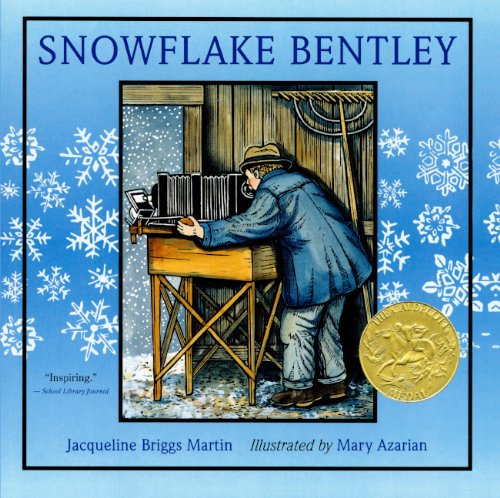
Snowflake Bentley
Dear reader, this is the time of year to check out the 1999 Caldecott Medal book Snowflake Bentley (c 1998), not only for Mary Azarian's award winning woodcuts "handtinted with watercolors" but also for the intriguing history lesson / biography by Jacqueline Briggs Martin of the man who gave us the first close-ups of a snowflake. Find out about Wilson Bentley's passion for snow and perseverance to discover a way to photograph snowflakes.
Here's a portion of the publisher's book review:
"Often misunderstood in his time, Wilson Bentley took pictures that even today reveal two important truths about snowflakes: first, that no two are alike, and second, that each one is startlingly beautiful."
And while the publishers recommend this particular picture book to ages 4-8, the history lesson is presented in such a beautiful way that you really should have your eldest children read it to their younger siblings. Then, for those older siblings, check out Snow Crystals and/or Snowflakes in Photographs both by W. A. Bentley himself.

All ages will especially like looking through the original photographs of MANY individual snowflakes. Afterwards, feel free to make your own snowflakes, as we did, using Lauren Stringer's tutorial (in correlation to her previously posted book, Snow).
Happy snow day!
Here's a portion of the publisher's book review:
"Often misunderstood in his time, Wilson Bentley took pictures that even today reveal two important truths about snowflakes: first, that no two are alike, and second, that each one is startlingly beautiful."
And while the publishers recommend this particular picture book to ages 4-8, the history lesson is presented in such a beautiful way that you really should have your eldest children read it to their younger siblings. Then, for those older siblings, check out Snow Crystals and/or Snowflakes in Photographs both by W. A. Bentley himself.

All ages will especially like looking through the original photographs of MANY individual snowflakes. Afterwards, feel free to make your own snowflakes, as we did, using Lauren Stringer's tutorial (in correlation to her previously posted book, Snow).
Happy snow day!
Subscribe to:
Comments (Atom)