Tuesday, November 15, 2011

Burt Dow Deep-Water Man


Oh, goody!  We discovered another book by Robert McCloskey: Burt Dow Deep-Water Man: A Tale of the Sea in the Classic Tradition (c. 1963).  I hardly thought it could be possible!

Burt Dow Deep-Water Man reveals a master story-teller at work.  First, McCloskey uses onomatopoeia (words that mean what they sound like) to relate this tall tale.  Listen to these lines to hear the onomatopoeia:
  • When Burt Dow puts out to sea in the Tidely-Idley, everybody in town knows it.  They hear him pump out all the water that has leaked in overnight, slish-cashlosh, slish-cashlosh! . . .   Then they hear him start the make-and-break engine, clackety bang! clackety bang! . . . 

  • . . . The giggling gull was teetering to and fro on the tip of the tiller and tittering "Tee-he-he-hee!" now and then, in a nervous sort of way.
Then McCloskey evokes perfect rhythm while weaving his spellbinding tale.  We all know McCloskey as a brilliant illustrator.  However, I challenge you to close your eyes and listen to Burt Dow read aloud . . . you'll discover that the text can stand on its own.  Yes, it's a rare jewel that displays the craft of oral storytelling at its best

So how did Burt Dow get from here:

to here:

Well, you'll have to read this little treasure of an adventure to find out!

By-the-way, here's another title that the fellas would enjoy.

Monday, November 14, 2011

Wind Has Shaken Autumn Down


Wind has shaken autumn down
left it sprawling on the ground,
shawling all in gold below,
waiting for the hush of snow.
~  Tony Johnston

from Snow Toward Evening: A Year in a River Valley / Nature Poems Selected by Josette Frank with Paintings by Thomas Locker.

Sunday, November 13, 2011

Beatrix Potter's Autumn

Beatrix Potter teaches her young audience a few important (and humorous) lessons with her Autumn tales.


First she issues a warning through the example of Squirrel Nutkin (c. 1903).


While the squirrel clan harvests nuts into their storehouses, 


Squirrel Nutkin teases and mocks Old Mr. Brown, the owl, with foolish riddles.  We soon find that Nutkin can disrespect his elder only so much before Mr. Brown bites off his tail.


Then we come to Timmy Tiptoes (c. 1911). 


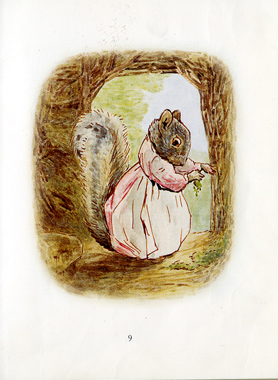
Here Timmy Tiptoes' wife Goody Tiptoes (I'm especially fond of this squirrel illustration) prepares her home for the winter.


Timmy and Goody work hard and fast to store nuts for their hibernation.  Unfortunately, some other squirrels jump to conclusions, suspecting Timmy of stealing nuts.


And they punish Timmy by dropping him into a hollowed tree, unknowingly onto his own storehouse.  While Goody searches for Timmy, Timmy gorges himself on nuts, so much so that he cannot escape through the hole once Goody finds him.  Eventually circumstances right themselves, and Timmy and Goody reunite.


Last, but certainly not least, we have The Tale of Ginger and Pickles (c. 1909).


 This story may be enjoyed by the parents more than the children, for it holds a timely commentary on our present economic atmosphere.  For you see:
                Ginger and Pickles gave unlimited credit.  Now the meaning of "credit" is this -- 
                when a customer buys a bar of soap, instead of the customer pulling out a purse and 
                paying for it -- she says she will pay another time.  (19)


Yes, friends, this synopisis' irony will be lost on the little ones.  We know the outcome of the story because we're living it.  But to hear it so succinctly expressed by the prophetess Beatrix Potter deserves a second glance.  If we had but heeded her warning!  Perhaps reading this little volume to the ones under our care will help prevent similar outcomes in their future. 

Thursday, November 10, 2011

Sky Tree


The reason you should purchase or check out Sky Tree: Seeing Science Through Art by Thomas Locker with Candace Christiansen (c. 1995) isn't because it tells such a wonderful story.  There's no reason to turn cartwheels over this text.  The real showstoppers are Locker's illustrations.  I can't think of a better way to tour the season.  And rather than writing about and describing them, I'm going to show you some selections:


Sunday, November 6, 2011

Homer Price


There are some authors that you wish had written more because you're desperate to read more of their work.  Robert McCloskey remains one of those author-illustrators for many of us.

Homer Price (c. 19) keeps us howling in its series of tall tales.  The first chapter begins the hilarity with an unassuming skunk who, along with Homer Price, saves the day when capturing notorious robbers on the run.


Fortunately for those who love Homer Price, McCloskey has a follow up chapter books: Centerburg Tales (c. 19).

I quite frequently receive requests for titles for boys.  I haven't met a fella (or a girl) yet who didn't enjoy the antics of Homer Price.

Saturday, November 5, 2011

Home


I brought Thomas Locker's HOME: A Journey Through America (c. 1998) home from the library, laid it out on the coffee table, and waited.  My youngest picked it up, poured over it, and came running to me: "Mommy, this pictures look beautifully!"


That afternoon the eldest came home from school, poured over the new-found book, and said, "Momma, you have got to look at these pictures!  These are my favorites."


I think old and young alike are amazed that Thomas Locker shares his magnificent oil on canvas landscape paintings not only in art galleries or museums but in childrens' books for all to enjoy.  Seriously, introduce your child to the fine art of Thomas Locker.  You may be astonished at the art appreciation that issues out of his/her mouth.

Wednesday, November 2, 2011

William Cullen Bryant

"Autumn, the year's last,
loveliest smile."
William Cullen Bryant

is published in sharing the seasons: A BOOK OF POEMS selected by Lee Bennett Hopkins and illustrated by David Diaz (c. 2010).

Sunday, October 30, 2011

Popcorn


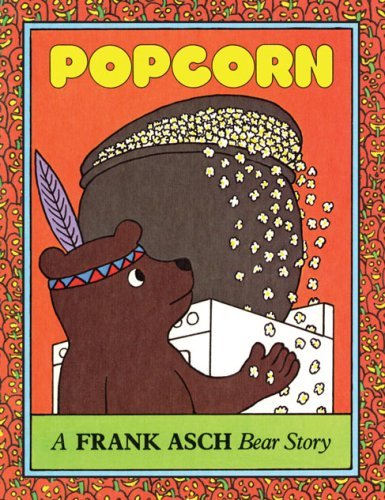
Popcorn (c. 1979) is just one of those books that you have to read and experience for yourself.  Written and illustrated by the beloved Frank Asch (of Happy Birthday Moon), it's a Halloween costume party sure to surprise.  Oh, and a quick word of warning, read it before you decide to pop your popcorn.

Sunday, October 23, 2011

The Spider and the Fly

As you all know, Halloween is quickly approaching.  Do you have any spooky stories to read to the kids?


If not, I highly recommend The Spider and the Fly (c. 2003) based on the cautionary tale by Mary Howitt and illustrated by Tony DiTerlizzi.


First of all, Mary Howitt penned the original poem "The Spider and the Fly" in 1829.  And, truth be told, this spooky tale employs an educational purpose of teaching children about the webs that flattery casts.  Think of that age old Biblical proverb "charm is deceitful . . . "


Now, consider this same lesson set against the backdrop of a 1920s haunted mansion.  DiTerlizzi received the Caldecott Honor for his illustrations, which he describes as inspired by "classic Hollywood film noir."  The only warning I would submit is this: DiTerlizzi's mesmerizing illustrations threaten to entice its viewers into minutes, possibly hours, of study and sighs.  Like a magician, the spider pulls quite a hat trick.


Update 10/31/11: Hi, readers!  Just wanted to let you in on a brief update: Nana went to her school library to borrow their copy (since I had hers) to read to her class.  Problem was it was worn out!!!  Seriously!  The librarian is presently ordering a new copy for her little eager readers.  Check it out for yourselves, I'm convinced you won't be disappointed!

Wednesday, October 19, 2011

Tuttle's Red Barn


Tuttle's Red Barn: The Story of America's Oldest Family Farm 
by Richard Michelson
Illustrated by Mary Azarian
copyright 2007

We stumbled upon this dear book, and even the kids sat through the whole long family tree of a story.  I'd sit here and chatter on about it for hours, but really, the publisher G.P. Putnam's Sons did such a fabulous job with its jacket leaf write-up that I won't reinvent the wheel in saying anymore:

The story of Tuttle's Red Barn is the story of America.  John Tuttle arrived in Dover, New Hampshire, in 1632 with only his father's ax an the two pewter candleholders his mother had given him after they'd hugged good-bye.  But from that humble beginning he built the farm that, today, still stands on the same land.

Twelve generations have tilled this New England soil, taking part in many great milestones of American history along the way.  The Tuttle family fought in the Revolutionary War, protected slaves on the Underground Railroad, and helped pave the way for the Industrial Revolution.  A Tuttle was even there to offer maple syrup to Abraham Lincoln when he visited Dover!

A fascinating look at America as seen through the eyes of one family, Tuttle's Red Barn is a must-read for anyone who appreciates the story of our country.  Caldecott medalist Mary Azarian's vibrant woodcut illustrations accompany Richard Michelson's informative and remarkable account of one family that has stayed connected through the centuries by a love of family, and one big red barn.

And if you'd like to see Tuttle's present day red barn and surrounding landscapes, here are some links:
http://www.flickr.com/photos/catchesthelight/3488876560/
http://richardmichelson.com/tuttle/book-release.html

Here's a fascinating interview with the illustrator, Mary Azarian:
http://richtexts.blogspot.com/2011/09/green-mountain-magic.html