As you all know, Halloween is quickly approaching. Do you have any spooky stories to read to the kids?
If not, I highly recommend The Spider and the Fly (c. 2003) based on the cautionary tale by Mary Howitt and illustrated by Tony DiTerlizzi.
First of all, Mary Howitt penned the original poem "The Spider and the Fly" in 1829. And, truth be told, this spooky tale employs an educational purpose of teaching children about the webs that flattery casts. Think of that age old Biblical proverb "charm is deceitful . . . "
Now, consider this same lesson set against the backdrop of a 1920s haunted mansion. DiTerlizzi received the Caldecott Honor for his illustrations, which he describes as inspired by "classic Hollywood film noir." The only warning I would submit is this: DiTerlizzi's mesmerizing illustrations threaten to entice its viewers into minutes, possibly hours, of study and sighs. Like a magician, the spider pulls quite a hat trick.
Update 10/31/11: Hi, readers! Just wanted to let you in on a brief update: Nana went to her school library to borrow their copy (since I had hers) to read to her class. Problem was it was worn out!!! Seriously! The librarian is presently ordering a new copy for her little eager readers. Check it out for yourselves, I'm convinced you won't be disappointed!
One parent's (and her kids') guide to navigating the library and bookstore. My recommendations in children's book classics . . . literature for little ones, then and now.
Showing posts with label Fairy Tale. Show all posts
Sunday, October 23, 2011
Wednesday, April 27, 2011
The Ugly Duckling
You know the tragic story: an egg is separated from its mother. It's eagerly adopted, hatched, and comforted by a mother duck who fiercely protects it against the tauntings of others. However, eventually the duckling is heckled away by his brothers and sisters. He seeks out to fend for himself. Driven from one home to the next, he finally arrives at pond/lake where he admires the beauty of the swans . . . only then does he discover the truth about himself.
Jerry Pinkney's illustrations (c. 1999) startle with the beauty and splendor of the natural world. Pinkney sparks sympathy and sensitivity through his strong yet graceful watercolors, which received the 2000 Caldecott Medal. Three-time Caldecott award winning Pinkney proves himself a master at his craft, so don't miss out on this book.
Friday, March 25, 2011
Paul Galdone wrap-up
Let's recap Read Me A Story's featured Paul Galdone titles (click on cover jacket to read more about that specific title):


Want to know more about Paul Galdone? Here's a start:
Now, for the winner of The Little Red Hen . . . congratulations to Sara!!! Check out Sara's blog: http://sara-mincy.blogspot.com/ Be on the lookout next week when I'll host another give away for the older children in your family.


Want to know more about Paul Galdone? Here's a start:
- birthplace ~ Budapest, Hungary, sources differ on the actual date of birth, reporting both 1907 and 1914
- immigration ~ with his family to the United Sates at 14 years old
- schooling ~ Art Student's League and New York School of Industrial Design
- work experience ~ busboy, electrician's helper, fur dyer, book jacket designer at Doubleday art department, four year stint in the U.S. Army Corps of Engineers, freelance designer/illustrator, children's book illustrator
- death ~ 1986, at which he had illustrated nearly 200 books, illustrating an average of six children's books a year from 1951 - 1986
- medium of choice ~ pen-and-watercolor in conjunction with black-and-white sketches
- illustrations ~ meticulously researched settings; carefully examined plants and animals; reflected small attention to detail and bold colors so beloved to children; often depicted the meadows, streams, gardens, orchards, and woodlands on and around his farm in Vermont; inspired by the masters Rembrandt, Goya, Hogarth, and Daumier
Now, for the winner of The Little Red Hen . . . congratulations to Sara!!! Check out Sara's blog: http://sara-mincy.blogspot.com/ Be on the lookout next week when I'll host another give away for the older children in your family.
Wednesday, March 23, 2011
The Three Billy Goats Gruff
The first time I read Paul Galdone's The Three Billy Goats Gruff (c. 1973) to the kids, I read it dramatically, giving voice to each character, and, consequently, scared them to death. Ooops! The second time I read it (a three-second follow-up to the first reading), I dropped the voices, and the kids loved the story. All that to say, Momma is scary and Paul Galdone is not.
You must pick up this book from the library! Galdone does a phenomenal job of retelling the classic folktale (which I believe originated in the Norwegian oral tradition - please, please correct me if I'm mistaken!) with his characteristic wit and humor. It depends on your child's sensibilities as to whether the troll is scary or not. We think he's ridiculously hideous . . . which lends a purposeful hilarity to the character.
Whenever we check out The Three Billy Goats Gruff, I get hoarse from re-reading it so many times (yep, the kids now beg for the dramatic voices). There's a certain satisfaction of good triumphing over bad that kids implore to hear again and again!
Tuesday, March 22, 2011
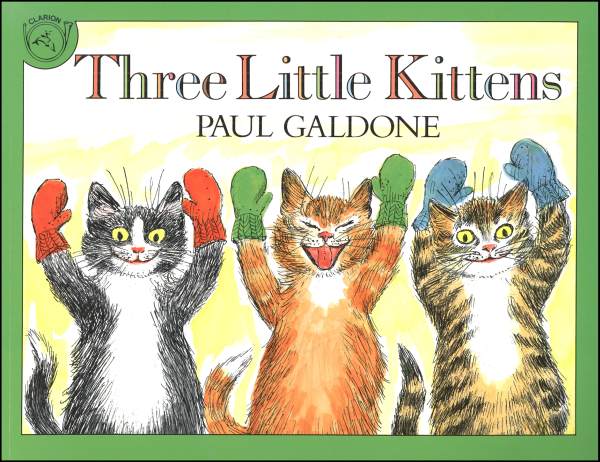
Three Little Kittens
You're familiar with the Mother Goose rhyme ~ one of our family's favorite ~ of the "Three Little Kittens," right? The rhyme begins with this first stanza:
Three little kittens lost their mittens,
And they began to cry,
"Oh, mother dear, we sadly fear,
Our mittens we have lost."
"What! Lost your mittens, you naughty kittens!
Then you shall have no pie."
"Meow, meow, meow meow."
There are an additional three stanzas that follow, which we enjoy singing as well as reading. Now, my kids were wild about this classic nursery rhyme before, but when Nana gave Galdone's interpretation (c. 1986) to our youngest this past Christmas, well, that just sealed the deal. Galdone's whimsical illustrations depict detailed scenes sure to capture any child's fancy. Toddlers and preschoolers especially enjoy a tale of "naughty" kittens desiring a slice of pie as well as Galdone's colorful illustrations.
Thursday, March 17, 2011
Give Away #2
The next book up for the March Madness give away is a gently used copy of The Little Red Hen (c. 1973) by Paul Galdone.
If you haven't picked up a title of Paul Galdone's fairy tales, then you're missing out on a real treat! I'm indebted to my Mom for so many things, one of them being her introduction to Paul Galdone's folk/fairy tales. Hungarian-born Gladone interprets the Brothers Grimm, Charles Perrault, and Hans Christian Anderson with an underlying humor that "lightens-up" the tale. His illustrated expressions just tickle my fancy!
Rather than spending weeks upon weeks on Paul Galdone's tales, I'm going to highlight our family favorites, starting with The Little Red Hen. However, I encourage you to search his name in your local library and discover your favorites.
The lesson of The Little Red Hen too often remains one that we'd all like to share with various adults we encounter . . . but then I digress. Children really identify with the justice of this tale that presents an occasion when it is okay not to share. And that last illustration . . . isn't it just priceless!
To enter the Galdone give away, post a comment by Wednesday evening. The winner will be selected at random and announced on Thursday.
If you haven't picked up a title of Paul Galdone's fairy tales, then you're missing out on a real treat! I'm indebted to my Mom for so many things, one of them being her introduction to Paul Galdone's folk/fairy tales. Hungarian-born Gladone interprets the Brothers Grimm, Charles Perrault, and Hans Christian Anderson with an underlying humor that "lightens-up" the tale. His illustrated expressions just tickle my fancy!
Rather than spending weeks upon weeks on Paul Galdone's tales, I'm going to highlight our family favorites, starting with The Little Red Hen. However, I encourage you to search his name in your local library and discover your favorites.
The lesson of The Little Red Hen too often remains one that we'd all like to share with various adults we encounter . . . but then I digress. Children really identify with the justice of this tale that presents an occasion when it is okay not to share. And that last illustration . . . isn't it just priceless!
To enter the Galdone give away, post a comment by Wednesday evening. The winner will be selected at random and announced on Thursday.
Tuesday, January 4, 2011
The Elves and The Shoemaker
This book left my Mom's kindergarten class in wonder more than any other book of the season! If you're going to check out a copy of The Elves and the Shoemaker, this retelling from the Brothers Grimm illustrated by Jim LaMarche (c. 2003) is the one to get -- hands down. You know the story: a couple fallen on tough times sets out their final piece of leather to cobble into shoes the next morning. Only the next morning they're surprised to find beautifully handcrafted shoes that instantly sell.
My children were especially drawn to the elves and the shoes -- the elves because they've cleverly been depicted as children and the shoes because, well, just wait until you see them for yourself.
The illustrations are breathtaking -- think fairy tale set in old world Europe. Even the title and endpages are a delight. That needle and thread ties the book together in more ways than one. And if a classroom of kids and I haven't sold you on it, take a look at a few reviews:
- "Jim LaMarche's paintings are extraordinarily beautiful. . . . They indicate a deep kind of thinking about illustration in children's books." The New York Times
- "This dazzling picture book is an artistic triumph." School Library Journal
- "The luminous illustrations evoke a magical aura." The Horne Book
Thursday, December 16, 2010
The Gingerbread Boy
We're busy baking around here . . . making memories. One tradition that I carried over from my childhood is making large gingerbread boys to gift and to eat. Oh, they're delicious! I know, I know . . . everyone thinks their own baking is the best. But you'll appreciate this: last month, my sister-in-law said my brother still has a gingerbread cookie in the freezer from last Christmas that he's saving for the first of December; she ended by saying, "And he won't let me have it!" So, I'm asking you, how many of you save your Christmas baked goods until the following November? It's that good!
And it should be -- because boy is it labor intensive! I feel like I've been rolling, cutting-out, baking and cleaning, decorating and cleaning with the kids all day. Wait . . . that is what I've been doing all day! Meanwhile, what I'm baffled by is that when I was growing up, my Mom did this for all three of our classes. How did she do that? But boy have the kids enjoyed it! And when we were all done, I thought I'd never recover from the pleading of them wanting to do more. What a fun and memorable experience!
The traditional reading a tale of The Gingerbread Boy accompanies the baking of gingerbread boys around our house. You know the tale: a charming elderly couple bakes a gingerbread boy who in turn runs away as soon as the oven door opens. Then everyone and their brother salivatingly chases that little rascal gingerbread boy as he mockingly and boastfully sings:
Run, run -- as fast as you can!
You can't catch me! I'm the gingerbread man!
I ran away from the little old lady and the little old man.
And I can run away from you too, I can, I can!
I grew up with the Little Golden Book edition pictured above (c. 1965, reprinted 1978) entitled The Gingerbread Man, which has quite an unsentimental ending: And that was the end of the gingerbread man. But then, nobody felt bad about that. After all, everybody knew that gingerbread men are baked to be eaten.
However, I have to say that as endeared to the Golden Book edition as I am, I also love Paul Galdone's edition (c. 1975) entitled The Gingerbread Boy. I find it interesting that in Galdone's story the charming elderly couple is childless, hence their rationale to fashion a gingerbread boy, which, of course, makes the ending a bit more pitiful. If you haven't checked out a Galdone book yet, now is the time!
Either way, I'm telling you, those gingerbread boys are as sought after as square footage in Manhattan!
And it should be -- because boy is it labor intensive! I feel like I've been rolling, cutting-out, baking and cleaning, decorating and cleaning with the kids all day. Wait . . . that is what I've been doing all day! Meanwhile, what I'm baffled by is that when I was growing up, my Mom did this for all three of our classes. How did she do that? But boy have the kids enjoyed it! And when we were all done, I thought I'd never recover from the pleading of them wanting to do more. What a fun and memorable experience!
The traditional reading a tale of The Gingerbread Boy accompanies the baking of gingerbread boys around our house. You know the tale: a charming elderly couple bakes a gingerbread boy who in turn runs away as soon as the oven door opens. Then everyone and their brother salivatingly chases that little rascal gingerbread boy as he mockingly and boastfully sings:
Run, run -- as fast as you can!
You can't catch me! I'm the gingerbread man!
I ran away from the little old lady and the little old man.
And I can run away from you too, I can, I can!
I grew up with the Little Golden Book edition pictured above (c. 1965, reprinted 1978) entitled The Gingerbread Man, which has quite an unsentimental ending: And that was the end of the gingerbread man. But then, nobody felt bad about that. After all, everybody knew that gingerbread men are baked to be eaten.
However, I have to say that as endeared to the Golden Book edition as I am, I also love Paul Galdone's edition (c. 1975) entitled The Gingerbread Boy. I find it interesting that in Galdone's story the charming elderly couple is childless, hence their rationale to fashion a gingerbread boy, which, of course, makes the ending a bit more pitiful. If you haven't checked out a Galdone book yet, now is the time!
Either way, I'm telling you, those gingerbread boys are as sought after as square footage in Manhattan!
Wednesday, September 29, 2010
Fairy Tales
Fairy tales originated in cultures and times long forgotten when stories and folktales were orally passed down from one generation to the next. We can give huge thanks to Jacob Grimm, Wilhelm Grimm (otherwise known as the brothers Grimm), Charles Perrault, and Hans Christian Andersen for researching and recording the oral stories that transport us into those ancient and fantastical worlds.
I grew up pouring over the stories and various illustrations from large edition called The Giant All-Color Book of Fairy Tales: 50 Best Loved Stories retold by Jane Carruth and published by Golden Press. We're all familiar with Walt Disney's version of fairy tales. The volume I grew up with related the unsaccharined version of fairy tale stories. Likewise, I've exposed my kids to unedited stories of Little Red Riding Hood, Rumpelstiltskin, Goldilocks and the Three Bears, The Three Little Pigs, The Princess and the Pea, and Cinderella quite early. And while my kids aren't too fearful of the dark or storms, they're terrified of wolves! They always cast the "bad guy" as a wolf or dragon in their pretend play. So, I would encourage you to preselect the volume you chose to introduce to your family.
My favorite volume is Classic Fairy Tales. The talented animator and illustrator Scott Gustafson does a beautiful job with the illustrations of his compilation. Take notice of his hearty, rosy-cheeked children. His illustrations soften any "scare" factor in the folktales.
Look for books with individual stories. We love:
Also, research other culture's versions of familiar stories. Take the Cinderella story, for instance, just about every culture or nation has a retelling of the Cinderella story, and it's fun to read the different ones! Start with Tomie dePaola's Adelita: a Mexican Cinderella story, The way meat loves salt: a Cinderella tale from the Jewish tradition by Nina Jaffe, and Yeh-Shen: a Cinderella story from China by Ai-Ling Louie.
I grew up pouring over the stories and various illustrations from large edition called The Giant All-Color Book of Fairy Tales: 50 Best Loved Stories retold by Jane Carruth and published by Golden Press. We're all familiar with Walt Disney's version of fairy tales. The volume I grew up with related the unsaccharined version of fairy tale stories. Likewise, I've exposed my kids to unedited stories of Little Red Riding Hood, Rumpelstiltskin, Goldilocks and the Three Bears, The Three Little Pigs, The Princess and the Pea, and Cinderella quite early. And while my kids aren't too fearful of the dark or storms, they're terrified of wolves! They always cast the "bad guy" as a wolf or dragon in their pretend play. So, I would encourage you to preselect the volume you chose to introduce to your family.
My favorite volume is Classic Fairy Tales. The talented animator and illustrator Scott Gustafson does a beautiful job with the illustrations of his compilation. Take notice of his hearty, rosy-cheeked children. His illustrations soften any "scare" factor in the folktales.
Look for books with individual stories. We love:
- The individual tales retold and illustrated by Paul Galdone!
- The Princess and the Pea illustrated by Dorothee Duntze
- Cinderella illustrated by Hilary Knight
- Goldilocks and the Three Bears published by Hart Publishing Company
Also, research other culture's versions of familiar stories. Take the Cinderella story, for instance, just about every culture or nation has a retelling of the Cinderella story, and it's fun to read the different ones! Start with Tomie dePaola's Adelita: a Mexican Cinderella story, The way meat loves salt: a Cinderella tale from the Jewish tradition by Nina Jaffe, and Yeh-Shen: a Cinderella story from China by Ai-Ling Louie.
Subscribe to:
Posts (Atom)